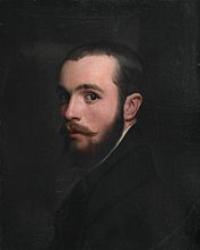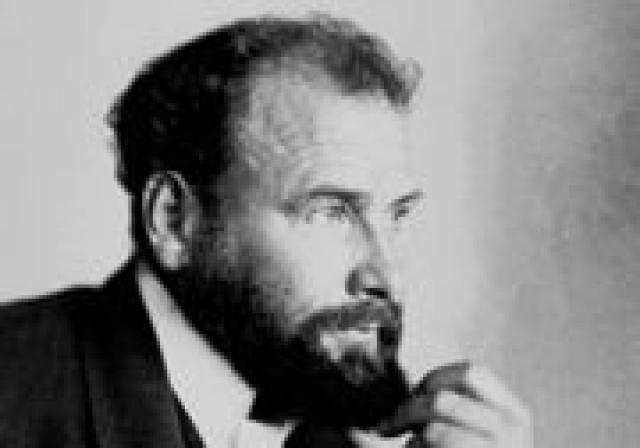
Gustav Klimt
 Austria
Biography of Gustav Klimt
Gustav Klimt was an Austrian painter, born on July 14, 1862, in Baumgarten near Vienna. He was the second child in a large family. At the age of 14, Gustav Klimt entered the School of Arts and Crafts in Vienna, where he studied under Ferdinand Laufberger and Julius Victor Berger until 1883. In 1877, his brother Ernst also enrolled in the same school. Together, they painted portraits from photographs, which they sold for 6 guilders per portrait.
From 1879 to 1885, Gustav Klimt, along with his brother and young artist Franz Matsch, worked on decorating theaters in the Austro-Hungarian provinces (in Reichenberg, Fiume, and Karlsbad) and ceilings in Viennese palaces. In 1880, he received his first significant commission - the "Four Allegories" paintings.
In 1886, during their joint work at the Vienna Burgtheater, Klimt's style began to differ from that of his brother and Matsch. From that time on, each artist worked independently. Upon completing their work at the Burgtheater, Klimt was awarded the Golden Cross for his services in the arts, presented by Emperor Franz Joseph.
In 1889, Gustav Klimt traveled through Europe, visiting Venice and Munich. In 1890, he worked on the decoration of the main staircase of the Museum of Art History in Vienna. After searching for his own style, Klimt moved away from academic drawing techniques. In 1891, he became a member of the Vienna Secession, an art movement, and in that year, he met Emilie Flöge, his future wife. In 1892, both Klimt's father and his brother Ernst passed away.
In 1894, Gustav Klimt and Franz Matsch received a commission to decorate the Aula Magna at the University of Vienna. In 1885, Klimt decorated the halls of the theater in Esterházy Castle in Hungary. In 1886, he painted murals with allegorical depictions of three faculties - "Jurisprudence," "Philosophy," and "Medicine." Klimt founded the Vienna Secession and became its president in 1887.
During the summer, Gustav Klimt spent his leisure time with Emilie Flöge in Kammer on Attersee, where he painted his first landscapes. Starting from 1898, the Secession exhibitions took place. During these years, Klimt developed as an expressionist, known for his ornamental depiction of forms filled with mosaics.
In 1902, Gustav Klimt created the Beethoven Frieze, which received widespread attention in the press. In the same year, he met Auguste Rodin, who was impressed by Klimt's frescoes. In 1903, the artist traveled to Italy, exploring Ravenna, Venice, and Florence. This marked the beginning of his "Golden Period." The panels for the Aula Magna at the University of Vienna were transferred to the Austrian Gallery, against which Klimt protested. In the same year, a retrospective of Gustav Klimt's works was held at the Secession.
In 1904, Klimt sketched the mosaic for the Stoclet Palace in Brussels, which was executed in the Viennese workshop. In 1907, Gustav Klimt met the young artist Egon Schiele. In 1908, sixteen paintings by Gustav Klimt were exhibited at the Kunstschau, and the Gallery of Modern Art in Rome purchased his painting "Three Ages of Woman," while the Austrian State Gallery acquired "The Kiss."
In 1909, Gustav Klimt began working on frescoes in the Stoclet Palace. He traveled to Paris, where he discovered the works of Toulouse-Lautrec. He also familiarized himself with the works of Van Gogh, Munch, Gauguin, Bonnard, and Matisse, which were exhibited at the Kunstschau. In 1910, Gustav Klimt successfully participated in the ninth Venice Biennale. His painting "Death and Life" received high praise at the World Exhibition in Rome in 1911. Klimt continued to travel to Florence, Rome, Brussels, London, and Madrid.
In 1912, influenced by the art of Matisse, Gustav Klimt changed the background color of "Death and Life" to blue. In 1914, expressionists criticized Klimt's works. In 1915, his mother passed away, and the artist's palette darkened. His landscapes tended to be monochromatic. In 1916, Gustav Klimt participated in the exhibition of the Association of Austrian Artists at the Berlin Secession, alongside Egon Schiele, Kokoschka, and Faistauer.
In 1917, Gustav Klimt began working on "The Bride" and "Adam and Eve." He became an honorary member of the Academy of Arts in Vienna and Munich. On February 6, 1918, Gustav Klimt passed away from a stroke, leaving behind numerous unfinished works. Over the next seven years, Egon Schiele, Otto Wagner, Ferdinand Hodler, and Koloman Moser also passed away.