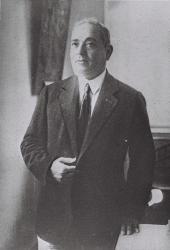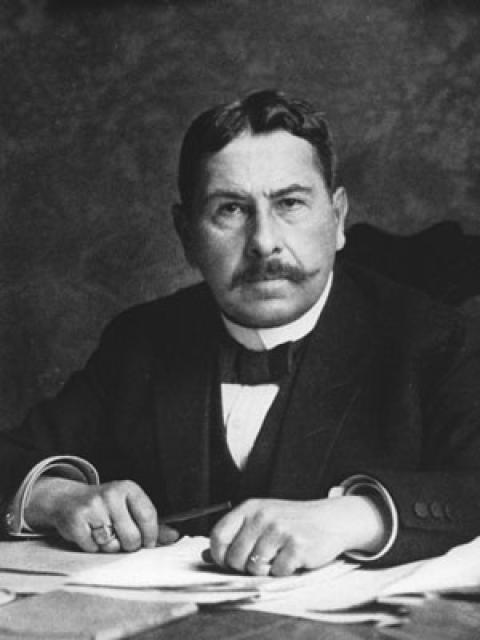
Gustav Ritter Von Kahr
 Germany
Biography of Gustav von Kahr
Gustav von Kahr was a German political figure and right-wing conservative. He is best known for his role in the failed Beer Hall Putsch of 1923, for which he paid with his life ten years later. Kahr was born in Weißenburg in Bayern, Bavaria. He initially studied law and even had his own practice, but later turned to politics and abandoned his legal career.
Early Political Career
From a political standpoint, Gustav von Kahr held monarchist positions, although he did not belong to any specific party. In 1917, Kahr became the head of the local government of Upper Bavaria. However, the German Revolution of 1918 resulted in his removal from office, although the revolution was quickly suppressed.
Premier of Bavaria
On March 14, 1920, Kahr replaced Johannes Hoffmann as the Prime Minister of Bavaria. His appointment was largely due to the Kapp Putsch that had taken place in Berlin the day before. The Bavarian People's Party, the most powerful political party in Bavaria at the time, had experienced internal conflicts due to the Bavarian Soviet Republic. With the support of Prussian and Württemberg troops, Hoffmann managed to defeat the Bolsheviks.
During the Kapp Putsch, the Bavarian government was literally expelled from its premises. Kahr then formed a new coalition government consisting of reactionary conservatives, who were gaining increasing strength, and supported by liberal publications sponsored by Prussian industrialists. Under Kahr's leadership, various right-wing movements flourished in Bavaria, including separatists who advocated for Bavaria's secession from Germany.
The End of Kahr's Career
After the German government issued a special decree to combat right-wing extremists, Kahr resigned. In September 1923, Prime Minister Eugen von Knilling declared a state of emergency in the country, and Kahr was appointed as the State Commissioner with almost dictatorial powers. Together with the head of the local police, Hans von Seisser, and the Reichswehr general, Otto von Lossow, Kahr's triumvirate had incredible influence.
Adolf Hitler, who was planning a large-scale coup in Germany, initially sought the support of Kahr's triumvirate. However, the future Führer did not interest Kahr, Seisser, and Lossow, as they planned to seize power themselves. On November 8, 1923, Hitler and his Stormtroopers attacked a meeting organized by Kahr in a Munich beer hall. Initially, it seemed that Hitler had the upper hand, but neither the army nor the police sided with him. Kahr, Seisser, and Lossow managed to prepare a counterattack, and they ambushed Hitler and his followers during their march from the beer hall to the War Ministry. The coup plotters could not put up a strong resistance and were quickly defeated.
Kahr's involvement in suppressing the coup cost him the support of right-wing parties, and it later became known that he himself was not averse to seizing power. In February 1924, Kahr was forced to resign. He then practiced law for a while but did not attract much attention. On June 30, 1934, during the Night of the Long Knives, Kahr was abducted by members of the SS. He was brutally murdered with an axe, and his body was dumped in a swamp near Dachau.