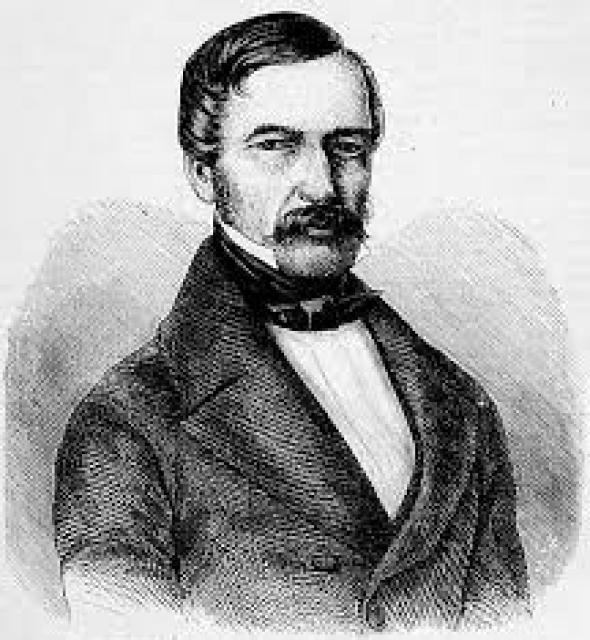
Gustaw Zielinski
 Poland
- Henryk Rzewuski: Polish Poet and Novelist
- November Uprising and Exile
- Literary Career in Siberia
- Return to Poland
- Later Works and Death
Henryk Rzewuski: Polish Poet and Novelist
Early Life and EducationHenryk Rzewuski was born on September 21, 1791, in the village of Bohatyrowce, Poland. His father was a colonel who had fought under Tadeusz Kosciuszko during the Polish-Lithuanian Commonwealth. Rzewuski received his early education in Toruń, then attended a Piarist school in Warsaw and a grammar school in Płock. In 1827, he enrolled in the Faculty of Law at the University of Warsaw, graduating in 1830.
November Uprising and Exile
Rzewuski participated in the November Uprising as a private soldier and became an officer after the Battle of Warsaw. He fled abroad with General Rybiński's troops but returned in 1832 after an amnesty. He rented a farm in Keja and devoted himself to writing.
In May 1834, Rzewuski was arrested and sentenced to exile in Siberia for supplying arms to A. Zawisza's partisan detachment. He spent a year in Tobolsk and seven in Ishim.
Literary Career in Siberia
During his Siberian exile, Rzewuski wrote his most famous works. He met with the Decembrist A. Odoevsky and the folklorist P. Ershov. He also studied Russian literature, influenced by Alexander Pushkin and Alexander Griboyedov. The Polish poet A. Januszkiewicz had a significant impact on him, providing him with a library and access to Kazakh language and folklore.
Rzewuski's romantic poem "Kirgiz" (1842), a portrayal of Kazakh life, was later translated into several languages and is considered one of his most important works.
Return to Poland
In 1842, Rzewuski was allowed to return to Poland. He managed his estate and that of his uncle, and became a literary figure in Warsaw. He edited the journal "Biblioteka Warszawska" from 1848, and his uncle's library became the foundation of the Scientific Society Library in Płock.
Later Works and Death
Rzewuski wrote articles for Orgelbrand's "Universal Encyclopedia" and the "Agricultural Encyclopedia." He also adapted Pushkin's story "The Peasant Maiden" into a play, "Panna-w?o?cianka."
Rzewuski died in Warsaw on October 18, 1881. His literary works, influenced by Romanticism and the "Ukrainian" school of Polish poetry, continue to be an important part of Polish literature.