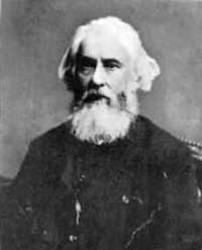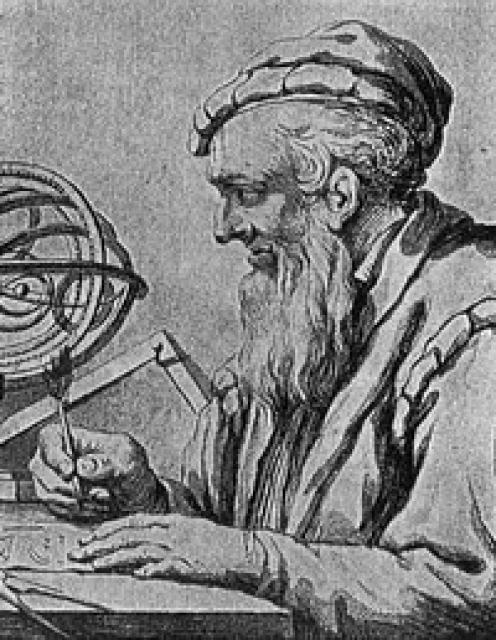
Gvido Bonatti
 Italy
Italy- Guido Bonatti: The Renowned Astrologer of the 13th Century
- Early Life and Education
- Court Astrologer and Prominent Advisor
- An Unforgettable Legend
- Academic and Practical Contributions
- Death and Legacy
- The "Book of Astronomy": A Monumental Work
- Contemporary Appreciation
Guido Bonatti: The Renowned Astrologer of the 13th Century
Guido Bonatti, one of the most influential practicing astrologers of the 13th century, was born in the early 13th century. Bonatti's birth location is disputed, with some sources claiming Fosso di Cascia near Florence, while others suggest Forlì.
Early Life and Education
Bonatti first studied law at the University of Bologna. However, he later transitioned to astronomy and astrology, his mastery in these fields earning him the esteemed title of "Siderabilissimus." Bonatti's initial known mention dates back to 1233, where he engaged in public debates in Bologna against astrology's opponent, Giovanni Schio da Vicenza.
Court Astrologer and Prominent Advisor
In the same year, Bonatti was appointed court astrologer to the Holy Roman Emperor Frederick II. His reputation continued to grow, and in 1260, he became the astrologer for the city of Florence. Bonatti's services were later sought by Count Guido da Montefeltro, a prominent figure in the Ghibelline faction. It is believed that Bonatti's astrological insights contributed to the count's numerous victories.
An Unforgettable Legend
Bonatti's most famous prophecy is the one he sent to Count Mont-Seran. He predicted that if the count made a sortie during a specific time, the enemy would be defeated, but that the count would be wounded in the thigh. The prophecy came true in every detail.
Academic and Practical Contributions
Throughout his life, Bonatti lectured on astrology at the universities of Paris and Bologna and practiced in various Italian cities. He is credited with authoring the "Book of Astronomy," a ten-volume treatise that is considered one of the most significant sources of information on medieval astrology in Europe.
Death and Legacy
Bonatti's death is believed to have occurred between 1296 and 1300, with different sources suggesting either Ancona or Cesena as the location. His exact circumstances of death remain unclear, with some claiming he was murdered, while others believe he died in a Franciscan monastery.
The "Book of Astronomy": A Monumental Work
Bonatti's "Book of Astronomy" has proven to be immensely popular since its creation in the 1280s, with numerous copies surviving to this day. The work has been translated into various languages and remains a testament to Bonatti's profound understanding of medieval astrology. In 1676, William Lilly featured 146 considerations from the book's fifth tractate in his own "Christian Astrology."
Contemporary Appreciation
In 1994, Bonatti's "Book of Astronomy" became the subject of a project by American astrologers. Despite ongoing research, a fully modern edition of the work is yet to be published. Guido Bonatti's legacy as an influential astrologer of the 13th century persists, inspiring and informing astrologers and historians alike.