John Lambe
 Great Britain
- Biography of John Lamb
- Early Career as an Astrologer
- Association with George Villiers
- Controversies and Execution
- Legacy
Biography of John Lamb
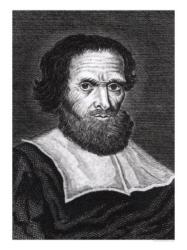
John Lamb was an English astrologer who worked for George Villiers, the 1st Duke of Buckingham. He was accused of witchcraft and rape and was stoned to death by angry Londoners. Not much is known about Lamb's early life, except that he taught in Worcestershire for some time. By the beginning of the 17th century, Lamb had gained a reputation as a knowledgeable astrologer and magician.
Early Career as an Astrologer
Identifying himself as "Dr. Lamb" (despite having no medical license), John predicted the future, diagnosed illnesses, removed curses, and practiced other forms of dark magic. He even claimed to be able to summon demons. It was rumored that Lamb charged 40-50 pounds for a session and actively offered his services to the people of London from 1608 to 1628.
Association with George Villiers
Around 1625, Lamb caught the attention of George Villiers, who was at the time the favorite of Charles I. Soon after, Lamb became the duke's personal advisor. Some believed Lamb to be a fraud, while others saw him as a genuine magician who controlled Villiers through dark means. The unpopularity of Charles I affected Lamb's reputation, as well. Stories of Lamb's supernatural abilities spread throughout London. Some claimed that he could inflict impotence on his enemies, while others connected him to strange natural phenomena near the Thames in 1626.
Controversies and Execution
There were skeptics in London who believed Lamb was simply manipulating gullible and superstitious citizens. However, they were in the minority, as the majority firmly believed that George Villiers was under the dangerous influence of the sorcerer. The townspeople tried to punish Lamb for his blasphemous actions, but their efforts were mostly unsuccessful, as Villiers and Charles I protected him. However, Lamb's luck ran out in 1627 when he was accused of raping 11-year-old Joan Seager. He received a death sentence but managed to secure a reprieve thanks to his powerful patrons.
On June 13, 1628, Lamb was stoned to death by a mob of revenge-seekers on his way out of the theater. Interestingly, no one faced punishment for the lynching, and George Villiers, the main protector of the sorcerer, died less than two months later.
Legacy
In 1653, four years after the death of Charles I, Lamb's former maid, Anne Bodenham, was hanged for witchcraft. Rumor had it that she possessed the ability to summon demons and transform into various animals. John Lamb's image, more often portrayed as a sorcerer than a cunning fraud, has been featured in literature. In 1628, an unknown author wrote his biography, and in 1634, the play "Dr. Lamb and the Witches" was published. Lamb was also mentioned in Walter Scott's "Letters on Demonology and Witchcraft."