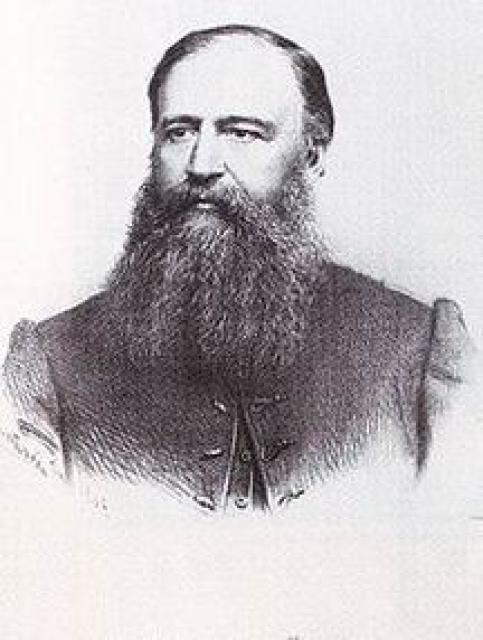
Gyorgy Klapka
 Hungary
- Early Life and Military Career
- Revolutionary Hero
- Victories Against Austria
- Defense of Komárom
- Exile and Return
- Prussian Involvement
- Amnesty and Later Years
- Death and Legacy
Early Life and Military Career
György Klapka, a Hungarian military commander and participant in the Hungarian Revolution of 1848, was born on April 8, 1820, in Temesvár, Transylvania (now Timișoara, Romania). In 1838, he joined the Austrian army and rose to the rank of officer.
Revolutionary Hero
In 1848, Klapka joined the Hungarian revolutionary forces, where he quickly rose through the ranks, becoming one of the leaders of the revolutionary army. After the outbreak of hostilities against the imperial army in late 1848, he replaced Lázár Mészáros as the commander-in-chief of the Northern Army. As commander, Klapka led an army of approximately 18,000 soldiers, operating in the north, in the territory of present-day Slovakia.
Victories Against Austria
In February-April 1849, Klapka achieved a series of victories against the Austrians, including the battles of Kápolna and Nagyszalló. In June, he participated in battles against the combined Austrian and Russian forces near the fortress of Komárom (present-day Hungarian Komárom and Slovak Komárno).
Defense of Komárom
In July, when the main Hungarian army led by Artúr Görgey retreated from Komárom, Klapka assumed command of the fortress's garrison. The Austrian siege of Komárom lasted until September 23 and was unsuccessful. Only after receiving news of the capitulation of all Hungarian forces did Klapka surrender the fortress on honorable terms.
Exile and Return
After the suppression of the uprising, General Klapka went into exile in Great Britain and later Switzerland. Along with Lajos Kossuth, he was one of the leading figures of the Hungarian émigré community.
Prussian Involvement
In 1864, Klapka was invited by Otto von Bismarck to Prussia to form a Hungarian Legion within the Prussian army, composed of émigrés and prisoners of war. Bismarck's plan was for Klapka's legion to instigate an uprising in Hungary once war broke out between Prussia and Austria. The 3,000-strong legion under Klapka's command managed to cross the border, but the Austrian defeat at the Battle of Königgrätz (Sadowa) led to a swift peace, and Klapka's corps returned to Prussia.
Amnesty and Later Years
Following the Austro-Hungarian Compromise of 1867 and the transformation of the Austrian Empire into the dual monarchy, Klapka, along with other Hungarian émigrés, received amnesty and permission to return to his homeland. Upon his return, he was elected to the Hungarian Parliament. He worked on the reform of Hungarian industrial enterprises and, in 1877, assisted in the reorganization of the Turkish army.
Death and Legacy
General György Klapka died on May 17, 1892, in Budapest. He was the author of memoirs published in Leipzig in 1850 and several other books. The English writer Jerome Klapka Jerome was given his middle name in honor of György Klapka, whose friend his father had become during Klapka's time in exile in Great Britain.


