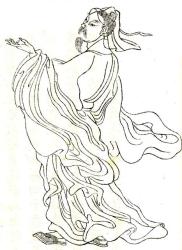
Habibulla Meshhedy
 Iran
IranBiography of Habibullah Meshhedi
Habibullah Meshhedi, also known as "Habibullah," "Habib Allah," and "Habib Allah Savaji," was a Persian artist who worked in the late 16th and early 17th century. Very little biographical information is available about this master. His name is only mentioned by the Persian chronicler Kazi Ahmed in his "Treatise on Calligraphers and Artists" (1596): "Mawlana Habibullah from Save, who lived in Kuma, became known for his skillful hands, and people pointed to him as a master in the art, he became the enchanting artist of his time, perfecting his craft day by day."
Early Life and Career
Habibullah's family hailed from the small town of Save, near Kuma. The history does not provide information about where he received his education or began his creative career. In a note from 1606, Kazi Ahmed reports that the governor of the city of Kuma, Hussein Khan, invited Habibullah to accompany him on a trip to Herat, but Prince Abbas took him away from the Khan and sent him to the capital - Isfahan, where Habibullah became an artist in the royal library. Shah Abbas I first mentioned Hussein Khan in September 1598, when Abbas himself was in recently captured Herat, and appointed Hussein Khan as the governor of the city, as well as the general-governor ("amir-al-omara") of all of Khorasan. The incident with Habibullah's invitation to the royal library in Isfahan probably occurred no earlier than 1601 when Abbas I had already made a splendid entrance into Herat with his entourage. This means that Habibullah lived and worked with Hussein Khan in Herat for at least two years - a city with ancient artistic traditions, and likely absorbed many of these traditions. With this creative baggage, the artist arrived in the capital. Some of his works were signed with the name "Habibullah Meshhedi." Some specialists believe that this indicates his long stay in Meshhed, while others believe that this prefix is not a result of his life or work in this city. They argue that the affix "Meshhedi" could well be the result of the artist's pilgrimage to the tomb of Imam Reza in Meshhed.
Notable Works
Habibullah's most famous work is undoubtedly the miniature for the mystical poem "Mantiq al-Tair" (Conference of the Birds) by Fariduddin Attar. The manuscript appeared a hundred years before it entered the library of Abbas I. It was created in 1486-7 by order of the Timurid ruler Hussein Bayqara. It contained four miniatures created during the Timurid rule. Shah Abbas I deemed it necessary to add one more - created by Habibullah. This astonishingly delicate work, full of natural mystery, features exquisitely rendered "portraits" of birds, which in this case symbolize souls. The miniature is stylistically close to the other four created during the time of Hussein Bayqara. The only exception is the figure of a man with a rifle, which is not mentioned in Attar's poem. It is likely the best illustration of his poem. Habibullah is attributed to quite a few works; the following have his signature: the miniature "Weighing Watermelons" from an undated copy of "Zafarnamah" (Private Collection); "Camel and Bearded Driver" (Private Collection); drawing with coloring "Youth Stringing a Bow" (Art and History Trust Collection, Houston); "Youth with a Rifle" (Berlin, Museum of Islamic Art); "Young Woman Holding a Pear" (Basil Robinson Collection, London); "Woman in an Orange Dress" (Topkapi Palace, Istanbul); "Young Hunter Loading a Rifle" (Topkapi Palace, Istanbul); "Camel" (Medelhavsmuseet, Stockholm); and "Stallion" (The Metropolitan Museum of Art, New York). These works are usually dated "around 1600."
In addition to these, Habibullah is attributed works in several manuscripts: three miniatures in the "Mantiq al-Tair," added during the reign of Shah Abbas I (The Metropolitan Museum, New York); twenty-six miniatures in the manuscript "Akh-Namah," created for the Governor of Herat, Hussein Khan (The Reza Abbasi Museum, Tehran); five album sheets with various drawings from the Morgan Library, New York, and several miniatures housed in the Chester Beatty Library in Dublin. Among his contemporaries, Muhammad, Sheikh Muhammad, Riza-yi-Abbasi, and others, Habibullah was the most conservative master. He did not rush to embrace new forms and subjects, adhering to the classical Persian tradition and "polishing" it to perfection. In his works, dissolved silver and gold are used not only for backgrounds but also for embellishing folds of clothing and faces - he worked in a unique technique that no one in Isfahan or Herat used at that time. Art historians speculate that in his youth, he may have studied jewelry making and worked with various materials. The date of his death is unknown.