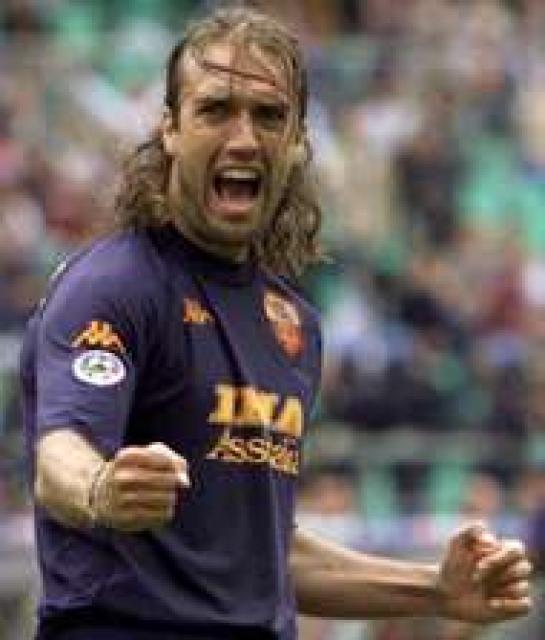
Habriel Batistuta
 Argentina
Biography of Gabriel Batistuta
Gabriel Omar Batistuta, an Argentine footballer and striker, will forever be remembered as one of the greatest forwards in the world. He is wealthy, handsome, famous, and admired by both men and women. But like any other person, he was once young, unknown, and broke. He had his fair share of difficult moments, periods of suffering and uncertainty, which he endured with dignity. Gabriel never shied away from wanting to live life to the fullest. He saw the unknown as a challenge to conquer. Everything Gabriel is and possesses today is rightfully earned through hard work, perseverance, and patience.
Early Life
Gabriel Batistuta was born on February 1, 1969, in the city of Avellaneda. At the time, the city had no idea that the biggest star of 90s football was born there. From this small town, not from Rekonkista, which is closely linked to Gabriel's life, a legend emerged. His childhood was spent under the watchful eyes of his grandfather, "Nonno" Melchior, and his father, Osma. "Nonno" Melchior was an important and loving figure in Gabriel's life. He was the head of the Batistuta family. Gabriel's life was always supported by the love and care from his mother, Gloria, with whom he had an incredibly close and special relationship. Despite facing economic crises during his childhood, Gabriel's carefree and happy upbringing was never tainted. Joy and love for life were always part of Gabriel's life. Even when things were not going well, he found happiness in fishing, playing ball, or dreaming. However, his imagination was limited by his ambitions.
First Steps as a Footballer
From the first matches played on the field they called "il lombrico" (the earthworm), known as La Bombonera, the Boca Juniors stadium, Batistuta's path was filled with difficulties, hard work, and, of course, luck. Without the goddess of luck, one can hardly go far, but we all know that to achieve goals, one needs to have more than just fate's help. In the end, only those who truly deserve it reach the pinnacle of success. Batistuta never considered himself a footballer, let alone a football star. His favorite sport was basketball. Who could have imagined then that he would reach the pinnacle of glory by scoring goals on the football field? He never thought about dedicating his life to football, never dreamed of becoming rich and famous. His story was full of difficult moments, missed opportunities, joy and tears, good and bad decisions, and, of course, many magnificent moments.
It was a simple coincidence that Batistuta made his debut in "big football" on September 25, 1988. In January 1987, a representative from Newell's Old Boys from Rosario "kidnapped" Batistuta from his hometown in a black car and took him on the path to fame. It was not an easy period for Gabriel, but his father, Osma, gave his consent to the man in the black car. "It's time to try, to spread your wings," he told Gabriel. When he arrived in Rosario, he faced obstacles that seemed insurmountable to him, but at the same time, he found good friends. Gabriel was lucky enough to convince the coach of his new team to have unwavering faith in him. The name of that coach was Marcelo Bielsa, who later became the coach of the Argentine national team. In the Argentine championship, our "Re-Leone" (Lion King) made his debut in a match in Tucuman against San Martin, playing for half an hour. They lost 1-0. But what everyone calls his real debut happened three days later when Newell's forward, Gabrich, got injured. Batistuta then wore the number nine shirt in the semi-final of the Copa Libertadores against San Lorenzo. He didn't score, but he "left his heart" on the field. Waking up the next day, the first thing he saw were newspaper headlines in unison saying, "Batistuta - a new star is born!"
However, Gabriel was not able to win everyone over. Some past champions, great players like Passarella and Sivori, believed that he did not deserve such attention. Time showed that they were better at playing football than understanding people. And there came a time when they realized they were wrong. Batistuta ignored Passarella when he played for River Plate while Passarella was the head coach of the Argentine national team. Sivori inexplicably lambasted Batistuta in the media until recently when he seemed to have suffered some sort of amnesia about everything he had ever said against Batistuta. But Batistuta never felt the need to seek revenge or demand apologies. He never compared himself to others. He is Batistuta, and that says it all. A footballer who knows when to be humble, a man whose destiny is envied by all who once spoke ill of him. After leaving both Newell's and River Plate, Sestimio Aloisi, his manager and one who knows enough about the strategy of a player's growth, made it possible for him to join Boca Juniors. Boca, the team that will forever remain in Gabriel's heart. And he promised to finish his brilliant career as a footballer at Boca. Thanks to Aloisi, Batistuta also tried his luck in Italy for the first time. He flew to Italy to play for Deportivo in the Viareggio youth tournament. After the first match, Batistuta was beaming with joy, no wonder since he scored his first European hat-trick against CSKA Sofia. The Deportivo adventure ended in Turin in a penalty shootout, where Batistuta missed, celebrating his birthday in this way, as he turned 20.
One weekend, the coaches took the young players to a real "calcio" match - Fiorentina against Milan. Gabriel was struck by the number of spectators in the stands, their love and loyalty to the Viola squad, their support. That day, Batistuta could only dream that in two years' time, the love and loyalty of the fans would belong solely to him, forever...
National Team
Gabriel Batistuta's debut in the national team came on March 27, 1991, in a friendly match against Brazil in Curitiba. The team included Ruggeri, Goicoechea, Caniggia, and Alfio Basile on the bench. Batistuta was listed in the starting lineup but did not score. Caniggia scored in that match.
Argentina started the 90s looking simply stunning. The team included Kempes and Passarella, who won the World Cup in '77, and Maradona, who won the World Cup in 1986. This team had not lost in 33 consecutive international matches. It was a very talented team, with most players playing or planning to play in Italy.
Gabriel's first victory will never be forgotten. He won the Copa America in 1991, also becoming the tournament's top scorer with six goals. This is how Batistuta began his career in the national team. Many European clubs immediately wanted to see him in their ranks, but ultimately, he joined Fiorentina, a team that allowed Gabriel to return to the "purple and white" jerseys.
Argentina arrived at the 1994 World Cup. Balbo, one of Batistuta's closest friends, was also called up for the national team but was assigned to room with Caniggia. The team had legitimate claims for the championship. Batistuta was given another chance to prove himself, now that Fiorentina had been relegated to Serie B in Italy. He returned to the national team full of life and energy. Maradona also returned to the team. Argentina started the 1994 World Cup in the USA with a resounding 4-0 victory against Greece. Batistuta scored a hat-trick, and Maradona scored one goal. In the second match, they defeated Nigeria 2-0, with Caniggia scoring twice. However, fate had it that Maradona would leave the World Cup prematurely. "El pibe de oro" (the golden kid) was the charismatic leader of the team. His positive drug test was like a bucket of cold water for the entire team. The atmosphere in the national team changed significantly. Rumors spread that Diego had taken ephedrine, but the team refused to believe it. We will never know what really happened. But without Maradona, the team lost its rhythm of play and lost 3-2 to Romania, ultimately exiting the tournament.
Everything changed, and a new coach, Daniel Passarella, came to the team. Thus, the paths of "el caudillo" and Batistuta crossed again. The era of Passarella, the era of the "iron fist," began. It seemed like he could conquer the world. But that didn't happen, and the team's successes were far less than expected. They were eliminated from the Copa America, losing in the quarterfinals to Brazil on penalties, with the deciding penalty missed by Edmundo. The qualification tournament for the World Cup in France became an agony for Batistuta. He was not called up to the national team for almost a year. It seemed that Passarella simply did not want to see him in the team, and yet whenever he was invited, Batistuta scored and scored skillfully. During this time, Batistuta surpassed Maradona in goals scored for the national team, becoming its all-time leading scorer.
At the 1998 World Cup in France, Argentina was once again unlucky. The team performed poorly, although Batistuta was unstoppable, scoring five goals. They lost to the Netherlands in a match where Passarella replaced Batistuta with Crespo. It was a substitution that did not improve the team's attacking power. All of Crespo's efforts were in vain. After losing the World Cup, Passarella resigned, marking the end of his era. And Batistuta, continuing to be one of the best forwards in the "blue and white" jerseys, continued his marathon for the World Cup...