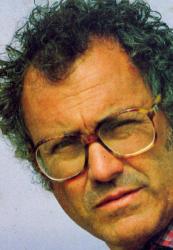
Haim Byalik
 Israel
Biography of Haim Nahman Bialik
Haim Nahman Bialik was an outstanding Jewish poet who wrote in Hebrew. He was born in 1874 in a poor family in one of the towns in Volhynia. After losing his father at a young age, he was sent to live with his grandfather, an old Talmudic scholar, in Zhytomyr. He was then enrolled in the Volozhyn Yeshiva, the highest school of Talmudic knowledge.
Bialik's life was filled with wanderings and a hard struggle for existence; it was only relatively late in life that he fully devoted himself to literature. In his later years, he lived in Odessa, where he managed one of the best Jewish publishing houses.
Motivated by deep national themes, Bialik vividly expressed the melancholy of Jewish life, the tragic horror of Jewish disintegration, the longing for the sun and a complete life, and the rebellion of the Jewish soul against centuries of servitude. Based on these main motives, Bialik's works can be divided into three categories. The first category includes pages that reflect, in symbols or in everyday scenes, the entire misery of Jewish existence. The second category consists of poems dedicated to life in all its fullness and beauty, inaccessible to the children of the ghetto. These are passionate hymns in praise of the sun, nature, and love. The third category comprises works in which Bialik embodies the protest and rebellion of the Jewish soul. Bialik's rebellion is not directly aimed at external oppression; for him, the main aspect of Jewish decline lies in the submission and passivity of Judaism itself, and he fiercely opposes this psychology of the "beaten slave" with rare strength of reproach and indignation. The most outstanding work of this kind is "The Tale of the Pogrom," a response to the events in Kishinev in 1903.
"Dead of the Desert" stands apart as Bialik's best poem, an original and artistically developed attempt to recreate the ancient grandeur of Israel, the days when the now humble people were still rebellious, a "cruel" tribe that knew how to fight against humans and God. In contemporary Hebrew poetry, Bialik occupies the first place. His poems are written in Hebrew, with some in colloquial Jewish language, and have been translated into European languages multiple times. In 1911, three collections of translations were published: in Russian by Jabotinsky ("Songs and Poems," 2nd edition, St. Petersburg, 1912), in German, and in Italian.