Hanns Eisler
 Germany
- Early Life and Education
- Musical Beginnings and World War I
- Political Activism and Music Collaboration
- Exile and International Collaborations
- Return to East Germany and Legacy
- Musical Style and Impact
Early Life and Education
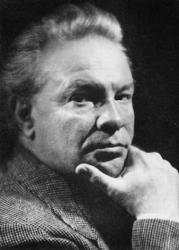
Hans Eisler was born into a prominent intellectual family in Leipzig, Germany. His father, Rudolf Eisler, was a renowned philosopher, while his sister was a communist activist and his brother a left-wing journalist. The family moved to Vienna in 1901, where Eisler pursued his education.
Musical Beginnings and World War I
Eisler's musical talents were evident from a young age. However, it was only after serving in World War I, during which he was twice wounded, that he had the opportunity to study music formally. In 1919, he enrolled at the Vienna Conservatory under the tutelage of Arnold Schoenberg.
Political Activism and Music Collaboration
In 1925, Eisler moved to Berlin and became involved in political activism. He joined the Berlin agitation and propaganda group and later led the militant workers' singing organization. During this period, he collaborated with notable writers such as Bertolt Brecht, Erich Weinert, and Johannes R. Becher, as well as singer Ernst Busch.
Exile and International Collaborations
With the rise of fascism in Germany, Eisler emigrated in 1933. He lived in several countries, including Austria, France, Denmark, England, the Soviet Union, and Spain, where he took part in the Civil War. During this time, he worked in Hollywood as a film composer and taught music.
Return to East Germany and Legacy
In 1948, Eisler returned to East Germany, where he became a professor of composition at the Berlin Academy of Arts. He was awarded the National Prize twice (1950 and 1958). His contributions to music were recognized with the naming of the Berlin Conservatory after him.
Musical Style and Impact
Eisler began his career as an avant-garde composer, writing atonal piano sonatas. However, influenced by the Russian Revolution, he shifted his focus towards music with a political and social message. He became renowned for his revolutionary songs, which featured march rhythms, simple instrumental accompaniment, and anti-bourgeois themes. These songs had a profound impact on the development of revolutionary music worldwide.