Hans-Jurgen (Dixie) Dorner
 Germany
Hans-Jurgen (Dixie) Dörner - A Legendary Footballer
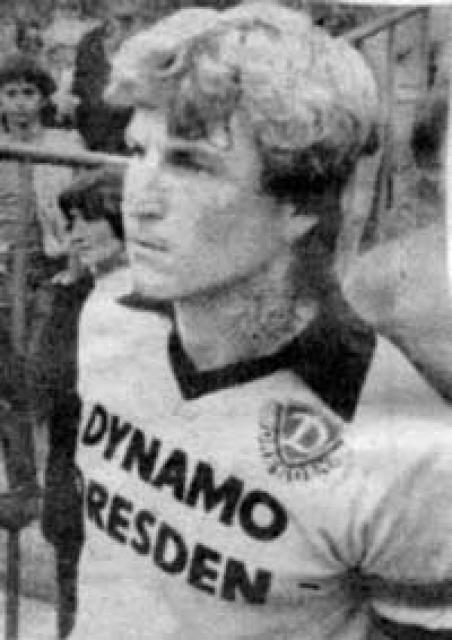
When it comes to discussing libero - the free central defender - the names Beckenbauer, Baresi, Kuman, and Shirea come to mind. One of the best liberos in the history of world football is also the famous player of the GDR national team and Dresden's Dynamo in the 1970s and 1980s, Hans-Jurgen Dörner, also known as "Dixie".
Biography
Dörner was born on January 25, 1951, in Görlitz, a city in East Saxony on the border with Poland. Despite being a large city with a population of 90,000, Görlitz had no football achievements, as its local teams never rose above the second division of the GDR championship. However, there were several football schools in the city due to its status as an industrial center, with each major enterprise having its own sports teams. Dörner was accepted into the youth section of the local team "Energie" at the age of nine. His love for football was limitless, and he almost gave up school for his favorite game. Only at the insistence of his parents did he manage to complete evening school. On top of that, Dörner trained as a turner. He earned his nickname, "Dixie", in Görlitz. He stood out among his peers in the youth teams, and at the age of 16, he made his move to the main regional team - Dresden's Dynamo.
The late 1960s were not the best period in Dynamo's history. In the 1967/68 season, the club was relegated from the Oberliga (top division) of the GDR championship. However, in the 1968/69 season, Dynamo confidently won the first division championship and returned to the Oberliga. It was in that championship that Dörner made his debut for Dresden. And what a debut it was! Playing as a central midfielder, Dörner scored 5 goals in just eight matches.
Starting from the 1969/70 season, Dörner became a regular player in Dynamo's starting lineup. He initially played in various positions - central midfielder, personal marker, and libero - but gradually the position of free defender became his main "job". The 1970s were a golden era for Dresden's Dynamo, with the team under the guidance of coach Walter Fritzsch winning the GDR championship five times (1971, 1973, 1976, 1977, 1978) and lifting the cup twice (1971, 1977). They also reached the quarter-finals of the European Cup and UEFA Cup, defeating the likes of Juventus, Porto, and Atletico Madrid. Throughout these years, Hans-Jurgen Dörner was one of the main contributors to his club's success, spending his entire career there.
Even as a libero, Dörner scored a considerable number of goals. He could take free kicks and penalties. In total, he scored 65 goals in the GDR's top division for Dynamo.
Dörner can be considered a football longevity. He played for Dynamo for 18 seasons, appearing in 392 matches in the Oberliga. This is the fourth-highest number of games played in the history of the GDR championships.
Dörner was named the best footballer in the GDR three times - in the 1976/77, 1983/84, and 1984/85 seasons. It is worth noting that he received this recognition twice in the 1980s when he was the oldest player in both Dynamo and the GDR national team. In the 1980s, he also won three more GDR cups (1982, 1984, 1985) with Dynamo.
Dörner also left a significant mark on the national team. He made his debut in June 1969, even before playing a single game in the Oberliga, and continued to play for the team until 1985. However, he never had the opportunity to participate in the final tournaments of the World Cup or the European Championship. He missed out on the 1974 World Cup, and the GDR national team failed to qualify for other tournaments, always falling just short of the coveted place.
But he did achieve a dream that every athlete in the world dreams of - in 1976, Dörner became an Olympic champion as the GDR national team won the Olympics in Montreal. He became the top scorer of the team and one of the tournament's best strikers, scoring 4 goals.
Dörner's distinguishing features were his excellent field vision, accuracy in shooting, and good physical fitness. He was also known for his ability to read the game, anticipate the opponent's attacks, and intercept passes. In other words, Dörner was a very intelligent player. Additionally, he possessed exceptional leadership qualities and was the captain of both Dynamo and the GDR national team. Furthermore, he played fairly and rarely received disciplinary actions. But above all, what impressed fans the most was his elegant playing style. He played with his head held high, excelling in ball retrieval, often dribbling past multiple opponents, causing heart attacks for coaches. He frequently joined the attacks and provided brilliant assists to his teammates. Due to his style of play, he was called the "Beckenbauer of the East," comparing him to the legendary Franz Beckenbauer. Dörner was loved by fans and journalists alike, always open to interviews and quick-witted.
In 1999, on the eve of the 100th anniversary of the German Football Association, surveys were conducted to determine the best players of the century in Germany. In the "libero" category, Dörner was consistently among the top three alongside Franz Beckenbauer and Matthias Sammer.
Hans-Jurgen Dörner made a colossal contribution to the development of football in the GDR. He became the epitome of an attacking defender, an example of an intelligent, elegant, and fair player.
After retiring from playing, Dörner became a coach. Fortunately, he obtained his coaching diploma while still an active player. He initially worked with children at the Dynamo school, then coached the GDR junior and youth teams. In 1990, he joined the coaching staff of the unified Germany national team upon the invitation of national coach Berti Vogts. He later coached the German youth teams and served as Vogts' assistant for one and a half seasons. He then spent some time as the head coach of Bremen's Werder in the Bundesliga. Under his guidance, the team finished ninth in the 1995/96 season and eighth in the 1996/97 season. After that, he coached the regional league club Zwickau for a year. He was then invited to coach Al-Ahly, the most successful team in Egypt. In 2001, Al-Ahly won the African Champions League and the Egyptian Cup under his leadership. However, for the first time in eight years, they failed to win the national championship. Dörner resigned, and his last coaching position was at the prestigious VfB Leipzig. However, the team currently struggles in the regional league and faces serious financial problems. Dörner left the club in March 2003.
Currently, Hans-Jurgen Dörner writes his football column in the "Sunday Saxon Newspaper" and spends his free time with his family. He is a model family man, having married at the age of 20. His wife, Eva, gave birth to two children - daughter Manuela (32) and son Steffen (23).
In an interview, Dörner confessed that his dream is to work again with one of the Bundesliga clubs.