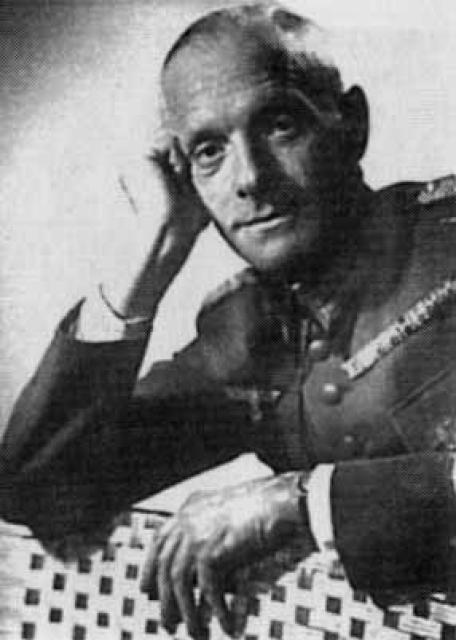
Hans Oster
 Germany
Biography of Hans Oster
Hans Oster was a German military figure and major general (1942) who participated in a conspiracy against Hitler. He was born into the family of an evangelical pastor and joined the military service in 1907 after completing his secondary education. As an officer of the General Staff, he participated in World War I and continued to serve in the Reichswehr after its conclusion. He was promoted to major in 1929. In 1932, due to a violation of the officer's code of honor (related to his involvement with his comrade's wife), Oster was forced to retire. In May 1933, he began working in the research department of the military aviation, and from October of the same year, he became a civil servant in the intelligence department (Abwehr) of the Ministry of War. In 1934, the murder of his former superior, General Kurt von Schleicher, by the Nazis contributed to Oster's negative attitude towards the Nazi regime. In 1935, Admiral Wilhelm Canaris, who became the head of military intelligence (Abwehr), reinstated Oster into the army and invited him to become the head of the central department of the service, responsible for personnel and finances. At that time, he was promoted to the rank of lieutenant colonel. In 1939, he was promoted to colonel, and in 1942, to major general. Like Canaris, Oster held nationalist-conservative views and had a negative attitude towards National Socialism. In 1938, he was one of the main participants in the conspiracy against Hitler during the "Sudeten crisis," which failed because England and France, pursuing a policy of appeasement, agreed to Hitler's demands to transfer the Sudetenland to Nazi Germany. This led to Hitler's growing popularity within the country and made it impossible to launch a military action against his regime.
Anti-Nazi Activities during World War II
During World War II, Oster continued to be involved in anti-Nazi activities. He provided information about Germany's upcoming attack on Belgium and the Netherlands to foreign countries. As the curator of personnel policy in the Abwehr, he facilitated the recruitment of many Nazi opponents, including Pastor Dietrich Bonhoeffer. He received information about planned persecutions of anti-fascists and warned them of impending actions. He participated in organizing secret missions for Bonhoeffer to Switzerland and Sweden, as well as for lawyer Joseph Muller to the Vatican. These individuals, officially acting as Abwehr employees, sought to establish contact with the British and Americans on behalf of the anti-Hitler opposition. Oster was also involved in plotting assassination attempts against Hitler. Hans Bernd Gisevius, a participant in the conspiracy against Hitler, recalled Oster as follows: "To a wider circle of people, Oster even seemed colorless. He depersonalized and embodied himself in specific actions. He described to me the functions that fell on his shoulders in the Resistance movement when he stood in front of his desk and, pointing to four or five telephones that connected him via a secret cable to various authorities, pondered, 'This is what I am! I have to be a mediator everywhere and in everything.' But he not only had to maintain daily telephone communication with generals and field marshals in their most distant headquarters. Oster was truly more than just a technician of the opposition. He was its driving force! And everyone clearly saw this when he was finally removed from his position."
Arrest and Execution
On April 5, 1943, as part of an investigation into the illegal transfer of currency abroad, Oster's colleague in the Abwehr, Hans von Dohnanyi, was arrested, and Oster unsuccessfully attempted to prevent the arrest. He then tried to hide compromising documents that Dohnanyi had not had time to destroy. On the same day, Oster was removed from his position. He was later accused of facilitating the release of the "unreliable" religious figure, Dietrich Bonhoeffer, from military service when he hired him at the Abwehr. As a result of the investigation, Oster was dismissed from military service. The general settled in Dresden, where he was under the control of the Gestapo, making it impossible for him to continue his active anti-Nazi activities. The participants in the conspiracy against Hitler planned to appoint him as the chairman of the Imperial Military Court. Fabian von Schlabrendorff, a participant in the conspiracy and future judge of the Federal Constitutional Court of Germany, believed that after Oster's removal, the Resistance lost its "commercial director" and only found an equivalent successor in Claus von Stauffenberg. On the day following the unsuccessful assassination attempt on Hitler on July 20, 1944, Oster was arrested. On April 8, 1945, he was sentenced to death in the Flossenbürg concentration camp along with Admiral Canaris and Pastor Bonhoeffer. They were hanged on the same day, with the condemned being stripped naked before being forced to walk to the gallows.
Personal Life
Hans Oster was married to Gertrude Knopp, who came from a family of Bremen textile industrialists. They had three children, one of whom, Achim, became a major general in the Bundeswehr. As a colonel, he served as the military attaché in Spain in 1962. In this role, Achim Oster, on behalf of the Minister of Defense at the time, Franz Josef Strauss, was involved in organizing the arrest of Conrad Ahlers, the deputy editor-in-chief of the German magazine "Der Spiegel," who was accused of disclosing confidential information about Germany's defense capabilities. This case, which ultimately ended in favor of "Der Spiegel" and led to Strauss' resignation, became a significant milestone in the relationship between the state and the media in Europe.


