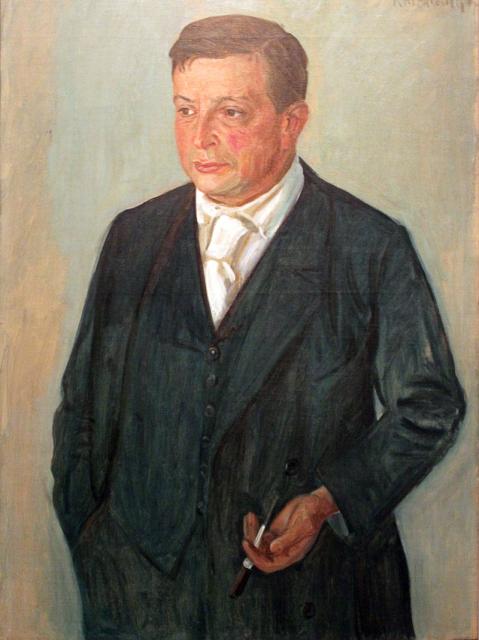
Paul Cassirer
 Germany
- Early Life and Education
- Founding of Bruno & Paul Cassirer Verlag
- Promotion of Impressionism
- World War I and Exile
- Return to Berlin and Political Involvement
- Personal Life and Death
Paul Cassirer: Art Publisher, Gallery Owner, and Advocate for Modern Art
Early Life and Education
Paul Cassirer, a Jewish-German art publisher and gallery owner, was born in Breslau, Germany. He studied art history in Munich and later worked for the satirical weekly "Simplicissimus" published by Albert Langen.
Founding of Bruno & Paul Cassirer Verlag
In 1898, Paul and his cousin Bruno Cassirer established their publishing house, "Bruno & Paul Cassirer, Kunst- und Verlagsanstalt." They introduced Berlin-based artists Max Liebermann and Max Slevogt to influential figures in the city. Through their connections to the Berlin Secession, they gained a prominent position in the art market.
Promotion of Impressionism
Cassirer and his brother became dedicated to promoting Impressionism, publishing works by Slevogt, Liebermann, and Corinth, whom they considered the avant-garde of German art. After a falling out with his brother, Paul continued the art dealership on his own and became president of the Berlin Secession in 1912.
World War I and Exile
During World War I, Cassirer volunteered for active duty but was deeply affected by the horrors of war and anti-Semitic attacks. He fled to Bern, Switzerland, with the help of friends, including Count Harry Kessler. In Bern, he founded "Max Rascher Verlags AG," which published pacifist writings by German and French authors.
Return to Berlin and Political Involvement
Upon returning to Berlin, Cassirer joined the German Social Democratic Party (SPD) and focused on his publishing work. During the 1920s, his publishing house published works by Ernst Bloch, Franz Marc, and Marc Chagall.
Personal Life and Death
Cassirer married twice: first to Lucie Oberwart, with whom he had two children, and later to actress Tilla Durieux. He attempted suicide in 1926 and died from its consequences on January 7, 1926. His publishing house continued to operate under the management of Walter Feilchenfeldt and Grete Ring until they were forced to emigrate after the rise of the Nazi regime.


