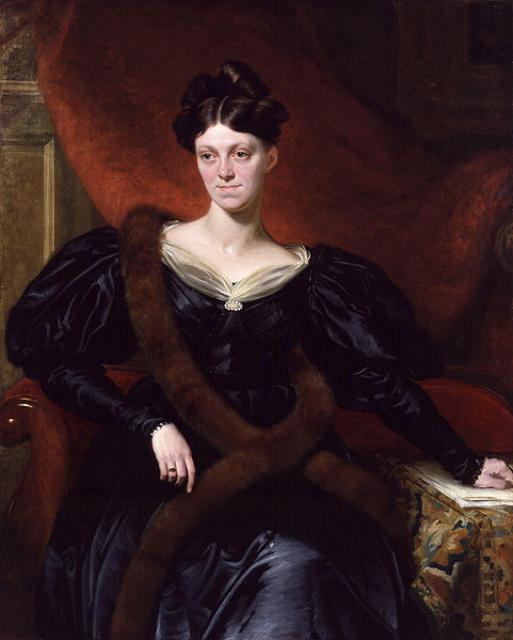
Harriet Martineau
 Great Britain
Harriet Martineau: The First Female Sociologist
Harriet Martineau was an English social theorist and writer who is often referred to as the first female sociologist. She wrote over 50 books and translated several works by Auguste Comte. Martineau believed that when studying society, one should focus on all aspects, including key political, religious, and social institutions. She also believed that the analysis of society should necessarily address the question of understanding women's lives. Martineau revolutionized sociological thought by addressing previously ignored issues such as marriage, children, domestic and religious life, and interracial relationships.
Early Life
Harriet Martineau was born on June 12, 1802, in Norwich, England, and was the sixth of eight children. Her father was a manufacturer, and her family belonged to a generation of French Huguenots and held Unitarian views. Her brother, James Martineau, was a clergyman who somewhat disagreed with English traditions. The household had a strict atmosphere, and hard work and intellectual pursuits were encouraged. Martineau was intelligent but weak and unhappy. She had almost no sense of smell or taste and became deaf from a young age, leading her to use a hearing horn. At the age of 16, due to deteriorating health and nervous exhaustion, Harriet stayed for an extended period with her father's sister, Mrs. Kentish, who ran a school in Bristol. Her time spent with kind and talented people made her life happier. She soon came under the influence of Dr. Lant Carpenter, a Unitarian minister, who, according to Martineau, "strangely blended awful spiritual severity with really respectable strength of intellect."
Writing Career
In 1821, Martineau began writing anonymously for the Unitarian publication "Monthly Repository," and in 1823, she published the work "Devotional Exercises and Addresses, Prayers, and Hymns." When her father died in 1826, leaving her mother and herself at the mercy of fate, Harriet had to earn a living. Unable to teach due to her deafness, she turned to writing seriously. In 1831, Martineau sought a publisher for her series of stories, and after many rejections, she agreed to unfavorable terms with Charles Fox, whom her brother William introduced her to. The sale of the first batch of books was a tremendous success, and demand increased with each new series of Martineau's stories, solidifying her literary success.
Later Life and Legacy
In 1832, Martineau moved to London, and in 1834, after completing her series, she traveled to the United States in support of the unpopular and controversial abolitionist movement. After a long-awaited meeting with her, Charles Darwin noted that "she was very agreeable, and he managed to talk to her on various interesting topics, considering the limited time."
In 1839, Martineau published her three-volume novel "Deerbrook," and the truthfulness with which she narrated the book "Maid of All Work" led many to believe that she had once been a servant doing all the household work. During her visit to continental Europe in 1839, Harriet's health deteriorated. She soon discovered that her chronic illness was related to an ovarian cyst and attempted to alleviate her suffering by repeatedly seeking help from her relative, Dr. Thomas Michael Greenhow.
From March 16, 1840, the writer lived for almost five years in Mrs. Halliday's boarding house near the town of Tynemouth in England. During this period, Harriet wrote at least three books and about a hundred pages of autobiography. Having resigned herself to the fact that she could remain an invalid for the rest of her days, Martineau "enjoyed her freedom" and used her telescope. Nonetheless, fearing to jeopardize her political independence, she twice refused a civilian list and, in 1844, felt better for a few months after agreeing to hypnosis treatment.
In 1845, she left the boarding house and built a home in Ambleside, where she spent the majority of her later life. Martineau successfully cultivated the land on her tiny farm and her impoverished neighbors owed her much. In her work, she was characterized by diligence and sincerity.
Harriet Martineau passed away on June 27, 1876. A posthumous two-volume autobiography was published in 1877. In a biographical essay published in the "Daily News," it was written: "Her original abilities were conditioned no more than by seriousness and intellectual clarity within a limited range. With limited creative and intellectual abilities, and therefore without anything resembling genius, she could clearly see what she saw and express what she needed to say. In short, she could advance ideas, even though she could not discover or invent anything new."


