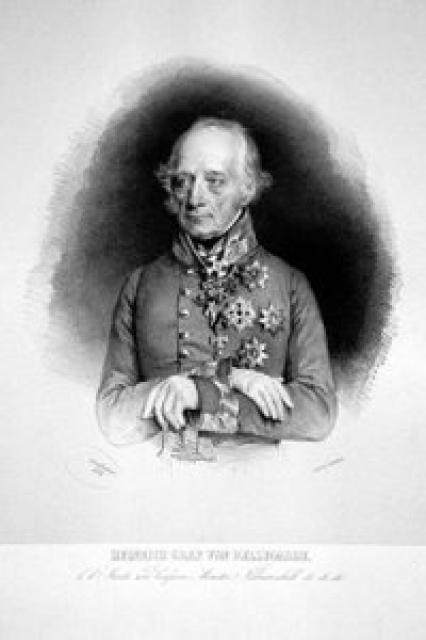
Heinrich Joseph Johann Bellegarde
 Austria
- Early Life and Military Career
- French Revolutionary Wars
- Napoleonic Wars
- Later Years
- Bellegarde died in Vienna on July 22, 1845.
Early Life and Military Career
Heinrich Johann Bellegarde was born on August 29, 1757, in Dresden. He initially served in the Saxon military before transferring to the Austrian service. In 1788–1789, he fought in the Russo-Turkish War as part of the Austrian auxiliary corps.
French Revolutionary Wars
Promoted to Major General in 1792, Bellegarde served as Chief of Staff to Wurmser from 1793 to 1795, fighting against France in the Netherlands. In February 1796, he was promoted to Field Marshal Lieutenant and appointed to the War Council under Archduke Charles.
In 1799, Bellegarde commanded a detachment protecting the communications between the armies of Archduke Charles and Suvorov. He successfully fought against Lecourbe, defeating him at Finstermünz, but was later defeated by General Moreau at Guliano. He then participated in the Battle of Novi.
Napoleonic Wars
During the 1800–1801 campaign, Bellegarde commanded the Austrian army on the Mincio and Adige rivers after Melas, but acted hesitantly and retreated behind the Brenta and Piave rivers.
In 1805, Bellegarde became a member of the Hofkriegsrat (the Austrian Military Council) and joined its presidency. He commanded the right wing of the Austrian forces at the Battle of Caldiero and was subsequently appointed Governor of the Venetian Provinces. In 1806, he was promoted to Field Marshal and named Governor-General of Galicia.
During the 1809 campaign, Bellegarde commanded an army group consisting of the I and II Corps, operating from Bohemia into Bavaria. He drove Davout from Regensburg and joined forces with Archduke Charles' main army. Commanding the I Corps, he participated in the battles of Aspern, Wagram, and Znaim.
Later Years
After the Schönbrunn Peace, Bellegarde returned to his previous post in Galicia. In 1813, with Austria's entry into the Sixth Coalition, he was appointed President of the Hofkriegsrat and Commander-in-Chief of the Austrian army in Italy.
In 1815, following Napoleon's return from Elba, Bellegarde defeated the forces of the King of Naples at Ferrara. From 1816 to 1820, he retired and lived in Paris.
Returning to Vienna, Bellegarde succeeded Prince Schwarzenberg as President of the Hofkriegsrat, holding the position until 1825, when he retired due to failing eyesight. In 1821, Russian Emperor Alexander I awarded Bellegarde the Order of St. Alexander Nevsky.