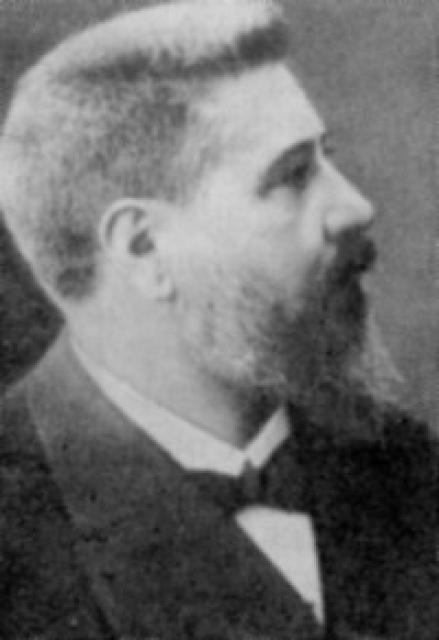
Henri Andoyer
 France
- Early Life and Education
- Academic Career
- Contributions to Celestial Mechanics
- Leadership and Honors
- Legacy
Early Life and Education
French astronomer and mathematician Henri Poincaré was born in Paris in 1854. He graduated from the École Normale Supérieure in 1884, where he studied mathematics and astronomy.
Academic Career
Poincaré worked as a professor at the University of Toulouse from 1881 to 1892. In 1892, he joined the University of Paris, where he became a full professor in 1903. He taught astronomy at the University of Paris for 37 years, and his lectures formed the basis for eight textbooks on astronomy and mathematics.
Contributions to Celestial Mechanics
Poincaré made significant contributions to the field of celestial mechanics. In his work "General Formulae of Celestial Mechanics" (1890), he demonstrated how trigonometric functions could be used to solve equations of motion with great accuracy. He also studied the special cases of the three-body problem and discovered the concept of Lagrangian libration points.
Poincaré's work on the stability of the solar system laid the foundation for modern studies in celestial mechanics. He developed special methods for calculating ephemerides, including a convenient method for calculating the motion of the Moon. He also compiled tables of trigonometric functions with 15 decimal places of accuracy.
Leadership and Honors
Poincaré was a member of the Paris Academy of Sciences (1919) and the Bureau of Longitudes in Paris (1910). He directed the publication of the French astronomical yearbook, "Connaissance des temps."
Legacy
Henri Poincaré's contributions to astronomy and mathematics have had a lasting impact on these fields. His work on celestial mechanics revolutionized our understanding of the stability of the solar system, and his methods for calculating ephemerides continue to be used today. His lectures and textbooks have inspired generations of scientists and mathematicians.


