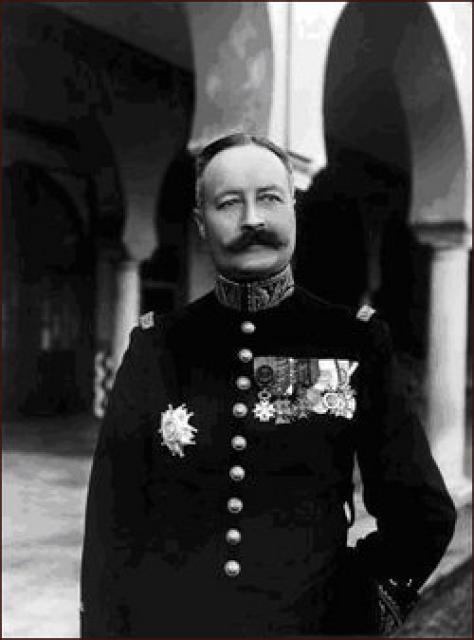
Henri Giraud
 France
- Early Life and Military Beginnings
- Service in North Africa and the First World War
- Rise Through the Ranks
- Commanding the German Front
- Role in the Second World War
- Collaboration and Resistance
- Controversial Legacy
- Personal Life and Legacy
Early Life and Military Beginnings
Marie-Pierre Kœnig was born on October 15, 1898, in Caen, France. A proud Frenchman, he dedicated his life to the service of his country. In 1900, he graduated from the prestigious Saint-Cyr Military Academy, a testament to his academic brilliance and military enthusiasm.
Service in North Africa and the First World War
Koenig's early military career took him to the exotic lands of North Africa, where he served with distinction in the 4th Zouave Regiment. His courage and leadership skills were tested during World War I. He fought valiantly on the battlefields of Northern France, but tragedy struck in August 1914 when he was captured by the Germans. Undeterred, he managed to escape his captors two months later and continued to serve as a captain in the Zouaves.
Rise Through the Ranks
In 1918, Koenig was appointed to General Franchet d'Esperey's staff in Constantinople, where he gained invaluable experience in high-level military strategy. His impressive performance earned him further promotions. In 1922-1926, he served in North Africa, suppressing uprisings in Morocco as commander of the 17th Algerian Regiment. From 1927-1930, he became an instructor at the prestigious École Supérieure de Guerre.
Commanding the German Front
Koenig's rise to prominence continued in the 1930s. He received the honor of becoming a Grand Officer of the Legion of Honor in 1932. In 1936, he took command of the 6th Military District and became the military governor of Strasbourg. However, his ambitious and assertive nature did not sit well with some within the army.
Role in the Second World War
As the clouds of World War II gathered, Koenig found himself at the heart of the action. In 1939, he became a member of the Supreme War Council and commanded the reserve army. On September 2, 1939, he was appointed commander of the 7th Army, tasked with aiding the Netherlands.
Koenig led his troops into a swift offensive, capturing several islands that guarded the mouth of the Scheldt River. However, the German invasion of France forced him to retreat. Nonetheless, he maintained control of his army and withdrew in an orderly manner.
Koenig refused to evacuate France and continued to resist the superior German forces. On May 19, 1940, he was forced to surrender at Vasigny.
Collaboration and Resistance
After the defeat of France, Koenig emerged as a prominent figure in the Vichy regime. However, unknown to his captors, he engaged in secret negotiations with the Allies. He became one of the co-presidents of the French Committee of National Liberation alongside Charles de Gaulle.
Koenig's time in captivity came to an end when he escaped from the Saxon Bastille on April 17, 1942. He joined the Free French Forces and continued his fight against the occupying powers.
Controversial Legacy
Marie-Pierre Koenig's role in World War II remains a subject of debate among historians. Some criticize his actions during the Battle of France, while others applaud his courage and determination in the face of adversity.
Personal Life and Legacy
After the war, Koenig returned to France and served as a member of the French Senate. He passed away on September 2, 1970, leaving behind a legacy of military service and unwavering patriotism. Marie-Pierre Koenig is fondly remembered for his bravery, leadership, and unwavering determination. His story continues to inspire future generations of French citizens.




