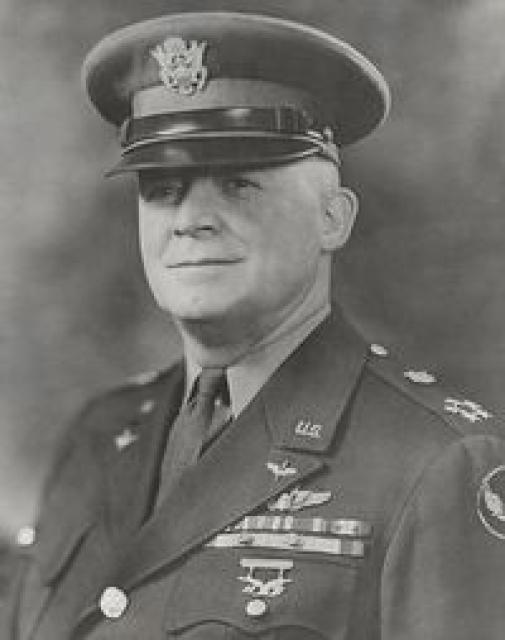
Henry Harley Arnold
 USA
USA- Early Life and Education
- Early Military Career
- World War I and Interwar Years
- Return to Aviation and Rise to Prominence
- Command of the Air Corps
- Leading the USAAF in World War II
- Post-War Life and Legacy
- Awards and Honors
- - Three Distinguished Service Medals
Early Life and Education
Henry Harley Arnold, a son of a prominent physician, was born on June 25, 1886, in Gladwyne, Pennsylvania. His early life was marked by his education at the Episcopal Academy, where he excelled in academics and athletics.
In 1903, Arnold graduated from high school and promptly enlisted in the United States Army. He was sent to the United States Military Academy at West Point, where he distinguished himself as a cadet and graduated in 1907 as a Second Lieutenant.
Early Military Career
Upon graduating from West Point, Arnold was assigned to the 29th Infantry Regiment, serving in the Philippines. In 1911, he transferred to the Signal Corps and became one of the first military aviators in the U.S. after receiving flight training in Dayton, Ohio.
Recognizing the potential of aviation, Arnold played a key role in the establishment of the Signal Corps Aviation School in Maryland. He also set an altitude record of 6,868 feet in 1912 and made several other successful flights while experiencing several plane crashes along the way.
World War I and Interwar Years
During World War I, Arnold served as the head of the Information Division of the Aviation Section of the Signal Corps but did not participate in combat. After the war, he held various positions in the military, including serving as a military attaché to the Philippines.
In 1924, Arnold graduated from the Army Industrial College and in 1929 from the Command and General Staff School. He then served in the Air Service Headquarters in Washington, D.C., but later transferred to the cavalry in Kansas due to conflicts within the Air Service.
Return to Aviation and Rise to Prominence
In 1929, Arnold successfully returned to the Air Corps but was assigned as the Chief of the Air Depot. From 1930 onwards, he held leadership positions in the Air Corps, including commanding an air district in California.
Arnold used his leadership platform to promote aviation and organized publicity stunts to attract public attention. He advocated for expanding the Air Corps and attracting aviation to support emergency relief and major events. In 1935, he was promoted to Brigadier General and became the Deputy Chief of the Air Corps.
Command of the Air Corps
After the tragic death of Air Corps Chief General Oscar Westover in an air crash in 1938, Arnold was appointed as his successor. As Chief, he spearheaded the development of new aircraft, including the B-17 Flying Fortress, and pushed for the development of jet aircraft.
When the United States Army Air Forces (USAAF) was created in 1941, Arnold became its first Commanding General. He oversaw the massive expansion of the USAAF during World War II, leading to a dramatic increase in aircraft production and personnel.
Leading the USAAF in World War II
Throughout World War II, Arnold commanded the USAAF and played a crucial role in the Allied victory. He advocated for supplying aircraft to the United Kingdom, planned all air operations, and secured the USAAF's status as an independent service branch.
Post-War Life and Legacy
After the war, Arnold retired from active service in 1946 after suffering a heart attack. He continued to write and work on his memoirs, entitled "Global Mission." In 1947, the USAAF was separated from the Army, a goal Arnold had long advocated for.
Arnold was promoted to General of the Air Force in 1949, making him the only individual to hold that rank. He passed away on January 15, 1950, and was buried in Arlington National Cemetery.
Awards and Honors
General of the Army Henry "Hap" Arnold was one of the most decorated military leaders in American history. His numerous awards and honors include the following:
- Three Distinguished Service Medals
- Legion of Merit- Distinguished Flying Cross
- Air Medal
- World War I Victory Medal
- World War II Victory Medal
- American Defense Service Medal
- Asiatic-Pacific Campaign Medal
- European-African-Middle Eastern Campaign Medal
- Order of the Southern Cross (Brazil)
- Grand Cross of the Legion of Honor (France)
- Grand Cross of the Order of the Aztec Eagle (Mexico)
- Knight Grand Cross of the Order of the Bath (United Kingdom)
- Order of Alaouite Throne (Morocco)
- Order of the Sun of Peru (Peru)
- Military Merit Medal (Mexico)



