Georg Keppler
 Germany
- Georg Kepler: Nazi, SS Obergruppenführer, and Military Officer
- Early Military Career
- Transition to the Police Force
- SS Career and Leadership
- Later Years and Death
Georg Kepler: Nazi, SS Obergruppenführer, and Military Officer
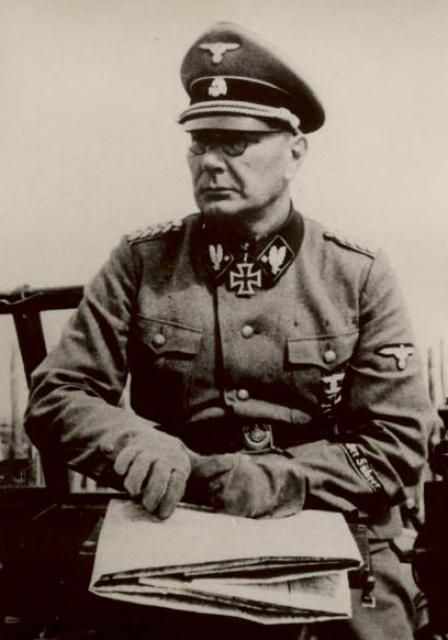
Georg Kepler was a prominent figure in the Nazi regime, serving as an SS Obergruppenführer and a military and police officer. He participated in both World Wars and received the Knight's Cross for his valor. Born in Mainz, Grand Duchy of Hesse, Georg was the son of Colonel Otto Kepler. Following in his father's footsteps, Georg decided to pursue a career in the army and enrolled in the military academy in Glogau in October 1913.
Early Military Career
In May 1914, Georg graduated from the academy and was assigned to an elite fusilier regiment. It was with this regiment that Kepler saw his first taste of the battlefield, but in August 1914, he was severely wounded and sent for treatment. Throughout the course of the war, Georg earned two more battle wounds and received the Iron Cross of both classes. After the signing of the first armistice in 1918, Kepler left the army and settled in Hannover.
Transition to the Police Force
On January 31, 1920, similar to Theodore Eicke and Josef Dietrich, Georg joined the local police force known as "Schutzpolizei." In July 1926, Kepler transferred to the state police and served in various units for the next eight years. However, after 14 years in the police force, Kepler grew tired of the uniform and decided to return to the army, although his stay was short-lived as he found the SS troops to be more intriguing.
SS Career and Leadership
After the annexation of Austria to Germany, Kepler was transferred to Vienna, where he led a special unit named after the Führer. He worked closely with Reich Protector of Bohemia and Moravia, Konstantin Freiherr von Neurath. In October 1939, Kepler's unit merged with an SS division, and he served as its commander during various operations on the Western Front, the Balkans, and Russia. In August 1940, Kepler was awarded the Knight's Cross on the personal recommendation of Paul Hausser.
Later Years and Death
Kepler continued to lead his old division until July 15, 1941, when he replaced the wounded Theodore Eicke as the commander of the Totenkopf Division. However, on September 21, 1941, Eicke returned to duty, and Kepler took command of the Nord Division. In the fall of 1941, Kepler began experiencing severe headaches, and it was later diagnosed as a brain tumor. Despite his illness, Kepler's career progressed, and he was promoted to Gruppenführer in January 1942. He limited his fieldwork and took on administrative roles in Bohemia and Moravia and later in Hungary on medical advice.
Kepler returned to active duty as an Obergruppenführer and participated in the later stages of the Battle of Normandy from August 16 to October 24, 1944. On October 30, 1944, he returned to the Eastern Front, leading his new unit until April 2, 1945. On May 22, 1945, Kepler surrendered to the American forces, becoming the last commanding officer of his army unit to do so. After the end of World War II, Kepler spent some time in prison but was released in 1948 and settled in Hamburg. He passed away on June 16, 1966, at the age of 72.