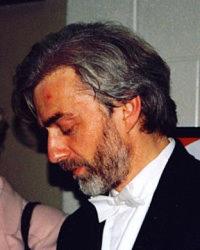
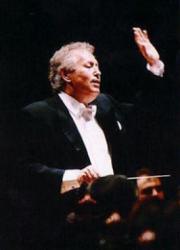
Herbert von Karajan
 Austria
Biography of Herbert von Karajan
Herbert von Karajan was an Austrian conductor and filmmaker, known for his work on films such as "Pagliacci," "Carmen," and "Beethoven's Ninth Symphony." He collaborated with Franco Zeffirelli, with whom he staged "La Bohème" (1963) and "La Traviata" (1964) at La Scala. In 1969, he founded the Karajan Foundation, which supports competitions for young conductors and orchestras. In 1983, UNESCO established the International Karajan Prize for his contributions to the development of musical art.
Early Life and Career
Herbert von Karajan (Karajan) was born in 1908 in Austria. He studied at the Mozarteum in Salzburg and the Vienna Academy of Music and Performing Arts. He began his conducting career at the theaters in Ulm, making his debut in 1929 with "The Marriage of Figaro," and Aachen (1933-1940), before moving to Berlin from 1938 to 1942. His first major success came with the production of "Tristan und Isolde" at the Vienna State Opera in 1937. In 1938, he staged "Fidelio" in Berlin.
During the years 1941-1944, Karajan served as the conductor of the Berlin State Orchestra. From 1947, he became the conductor (and later director) of the Society of Friends of Music in Vienna. In 1948, he made his first appearance at La Scala with "The Marriage of Figaro," and in 1954, he performed the opera "Lucia di Lammermoor" with Maria Callas in the leading role. He was the leading conductor of the Salzburg Festival (artistic director in 1957-1960 and 1964-1988), Bayreuth, Edinburgh (1953-1954), and Lucerne (1947-1956).
During the 1950s and 1960s, Karajan was hailed as the "General Music Director of Europe." From 1955 (after the death of Furtwängler) until the end of his life, he directed the Berlin Philharmonic Orchestra. From 1957 to 1964, he was the director of the Vienna State Opera, where he staged some of his best productions, including "Otello," "Parsifal," "Tristan und Isolde," and others. In 1967, Karajan founded the Salzburg Easter Festival. He also performed at the Metropolitan Opera, with notable productions such as "Die Walküre" (1967), "Tosca" (1988), and more. He was the first performer of Orff's opera "Triumph of Aphrodite" (1953, Milan) and others. Karajan also directed several significant opera productions, including "Boris Godunov" (1965) and Orff's "The Mystery of the End of Time" (1973), both in Salzburg.
Legacy
Herbert von Karajan was a renowned musician of the 20th century. He recorded almost his entire extensive repertoire, which mainly consisted of Austro-German music from Bach to Orff. Among his notable recordings are "Ariadne auf Naxos" by R. Strauss (with soloists Schwarzkopf, Streich, Prey, and others, EMI), Wagner's "Parsifal" (with soloists P. Hoffman, Van Dam, Moll, and others, Deutsche Grammophon), "Don Carlos" (with soloists Carreras, Freni, Cappuccilli, Baltsa, Ghiaurov, and R. Raimondi, EMI), "Madama Butterfly" (with soloists Freni, Pavarotti, Decca), and more. His contributions to the world of music earned him the establishment of the International Karajan Prize by UNESCO in 1983 for his achievements in the development of musical art.