Hetty Green
 USA
USABiography of Hettie Green
Hettie Green was an American financier and billionaire, known as the richest woman of her time. She was nicknamed "If I were a multimillionaire, I would probably find pleasure in wearing the oldest dress and being mistaken for a beggar." Fyodor Dostoevsky, the novel "The Adolescent." There is a legend that the great Russian writer Alexander Pushkin wrote the main character of "The Miserly Knight" based on his own father, Sergey Lvovich Pushkin. Whether this is true or not is unknown, but it is well known that Sergey Lvovich was quite stingy. According to the poet himself, his father was so greedy that he "skinned his peasants in 33 skins," starved the servants, never paid his debts, and could haggle even over small bills for months. Of course, greedy people can be found in all classes, estates, and social groups, but generosity is more appropriate for wealth rather than poverty. And if poverty and greed make a more or less logical combination, then wealth combined with greed is perceived by most people as extremely negative. Nevertheless, the miserly knight of Pushkin, Gobsek of Balzac, Harpagon of Moliere, Plyushkin of Gogol, and Scrooge of Dickens (please do not confuse with "the richest duck in Duckburg") could find a large number of prototypes among the highest echelons of the financial elite. Indeed, the largest number of misers and miserly people can be found among the richest individuals on this planet. On one hand, it is understandable: a millionaire would never become a millionaire, let alone a billionaire, without possessing qualities such as frugality, prudence, and modesty in satisfying one's own needs. As the classic wrote, the economy must be economical. Economical, and only that. However, too often in history, economy, exceeding all reasonable limits, turned into an obsession, and elementary practicality turned into a psychological deviation and perversion. The greed and pettiness of Henry Ford, John D. Rockefeller, and Mayer Rothschild, who were once the richest people in the world, amazed and continues to amaze people's imagination for a whole century. People who, even in a hundred long lives, could not spend even a hundredth of their incalculable wealth, were unbearable misers in everyday life, and living with them was like an endless nightmare. But all the aforementioned historical and literary characters may seem like examples of wastefulness and selfless service to the interests of others compared to one noble lady who in the first half of the 20th century became the richest woman of all time and earned unmatched authority in the field of stock speculation. Henrietta Green. This name has become synonymous with poverty, disgustingly dirty living conditions, and the hypocrisy of old-fashioned street trading. In her greed and avarice, she surpassed all the misers who ever existed on earth combined. Greed, as you know, can be perceived differently. For example, the manifestations of Ford's frugality (Ford often used ordinary washers instead of the buttons that fell off his jackets, which he always considered excessive luxury) and Rockefeller's frugality (he never subscribed to newspapers, preferring to read yesterday's editions, which he would casually ask for from his acquaintances) only caused a smile and mild surprise among contemporaries. Green's greed, on the other hand, could only evoke feelings of disgust. Disgust and hatred. "Old witch," "crazy rat," "greedy beggar," "bottomless barrel" - this is an incomplete list of the humiliating epithets with which Green's colleagues and close associates lovingly called her. And she found all of this dull and joyless. If some novelist took up writing a book about childhood dreams, thoughtful searches, first passionate love, travels, and lurking dangers at every step, Hettie would be the last person whose image the author would agree to take as a prototype of the main character. She was the complete opposite of an ordinary child her age. Gloomy, wary, unfriendly, and silent, the little girl scared not only the neighborhood kids but also their parents with her gloomy appearance. Children's games and amusements did not appeal to Hettie. Instead, she loved wandering alone in the surrounding areas and doing nothing. From the outside, it could seem like she was always waiting for something, especially since that was exactly what she was doing.
Henrietta Holland, born Robinson, was born on November 21, 1835 (according to some biographers, in November 1934) in the city of New Bedford. Here, in the Massachusetts port on the northeast coast of America, the future millionaire spent the best and most prosperous years of her long and half-starved life. Her father was a successful shipowner and owned several large whaling ventures in different parts of the city. Her mother, Abby Holland, came from a noble and wealthy family from the Old World. She received her secondary education there. Her rebellious nature and lively personality did not fit in with the prestigious Boston and Harvard colleges, where all the moneybags in America wanted to place their children, so the restless student successfully completed a one-year course in bookkeeping at a provincial school in Rhode Island. Returning home, she immersed herself in the everyday routine of the port city. To Hettie's credit, the majority of the qualities she possessed in her adulthood were developed on her own, without anyone's help. From her father, she inherited only a masculine physique, immense physical strength, and a habit of swearing at every step. At an early age, Hettie demonstrated extraordinary abilities in mental arithmetic and mathematical calculations. At the age of 10, when other children played with dolls and built toy models of sailing ships, the capable girl wandered around embracing her father's accounting journal and knew that two plus two equals three. She always wrote off one, like a Western bookkeeper, as a natural loss. Walking with her father and his brothers in the native port and numerous docks, Hettie participated in loading, weighing, selling, and even beating errant sailors. Her father could not be happier with his smart daughter. And the daughter hated both her father and his brothers and the whole city that smelled of fish and salt. Hettie calculated that even if they killed all the whales in the Atlantic Ocean, it would still not be enough to provide her with a decent and comfortable life without looking at the compass and changing weather conditions. The intelligent Hettie was attracted to the metropolis, and that's where she saw her future. The financial world of America did not easily yield to Green. It cannot be said that she faced a series of major setbacks, but she certainly lacked the ability to charm and the stars from the sky, and she did not strive for career advancement. She methodically and without irritating the young upstarts about the rapid success of young merchants, did her job: selling caught fish, building shipyards, and outfitting new whaling expeditions. Her waiting tactic was most suitable for her. She did not have personal money (everything earned with her father was deposited into his personal bank account), and even if she did, the customs prevailing in the Robinson family would not allow her to start her own business. The years passed. Hettie waited. Upstarts of the Rockefeller type grew rich before her eyes. Hettie waited. Productions, markets, banks, and other people's capital grew, new promising financial schemes were invented and implemented, and the dollar frenzy swept through and declined throughout America. Hettie waited.
And finally, the long-awaited time came. In 1864, her father died. New horizons opened up before her, enticing her with superprofits and power. But first, she had to settle some matters in her hometown of New Bedford. According to the will drawn up by the head of the family, all the money, amounting to seven million dollars and some change, went to Hettie, and the whaling business was transferred to the control of her deceased father's brothers. The brothers expressed surprise at the terms of the will and questioned its validity. The fact is that according to the established tradition in the Robinson family, both the business and the income from it were managed by the entire family (a noble Quaker community), and according to community rules, it was forbidden to bequeath one's property to any specific person.
At that moment, Hettie made it clear to her relatives that she was very serious, stating that she would personally kill and feed sharks to anyone who stood in her way to her parents' money. The determined girl decided to back up her words with action and burned down one of the family docks, which housed three large fishing vessels and a dozen rowing boats. Such an act shocked even the people who knew her well. Nonetheless, Hettie decided to put an end to her relationship with her family. Two years after Edward's death, her beloved aunt Sylvia Holland also died, dividing her estate equally among the members of the large family. What did Hettie do? She made a copy of the will, according to which her aunt's money went to her alone, and took it to court. No one expected such blatant treachery. Naturally, the court deemed this will a forgery, but the damage was done – she was finished with her annoying relatives, and her father's money was entirely at her disposal.
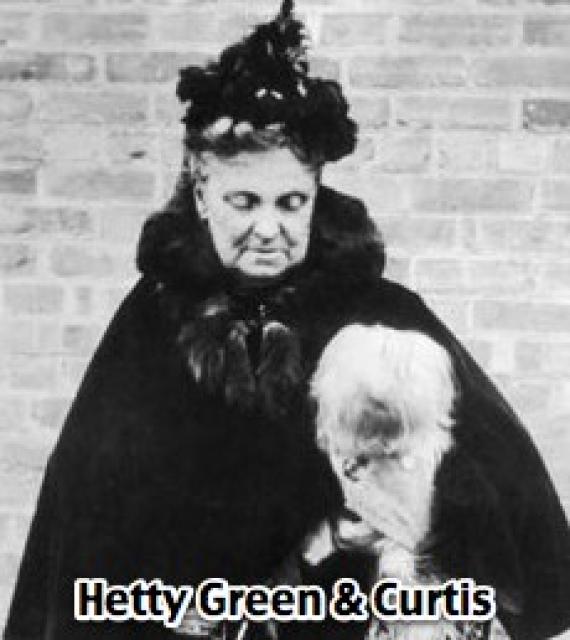
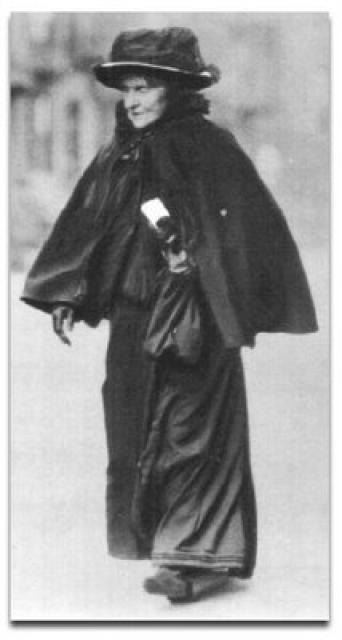
Next came Wall Street, the stock exchange, securities, calculations, forecasts, bets, fights with investors and their attorneys, losses, gains, and a reputation as a mentally unstable person. Paradise and a natural habitat for people like Hettie Green. If we compare and merge the memories of contemporaries, the appearance of the millionaire can only be compared to the image of Baba Yaga, brilliantly played by Georgy Millar in the films of the Soviet fairytale director Alexander Rou. A long nose, bulging wandering black eyes, a trembling protruding chin, and a hunched figure in gray dirty clothes could truly horrify anyone. And if we add to all this a rough command-type voice, huge, firm hands, and a habit of constantly expressing oneself with multi-storey obscene phrases, then the color of advanced stock trading will appear in all its unattractive glory.
The classic example of fraud in public catering establishments with the throwing of bolts and nuts into the dishes and snacks in the face of Lady Green acquired a fitting expression. "To the mistress of the stock exchange," it seemed very wasteful to throw bolts and screws, so she preferred to throw ordinary stones, which she collected from all the New York roads and construction sites, into soups and drinks. Her business partner, Adam Silvestre, once recalled that the large bag she carried with her all the time, in case of an unexpected meal in a restaurant, was filled with pebbles and dirt.
Her daily diet consisted of 300 grams of oatmeal with salt and 50 grams of black bread. She preferred tap water as a refreshing drink and refined sugar as a dessert. However, sugar, like butter, was extremely rare for Green – mainly on the occasion of receiving guests or on major holidays. By the way, such a diet was prevalent in the entire family. Hettie never indulged herself or her children with gourmet delights.
Even her young nephews once received the "generosity" of Aunt Hettie. In 1875, Hettie's cousin Lisa Bernstein brought her children, ten-year-old Betty and eight-year-old Joshua, to live with Hettie for the summer and tearfully asked her to look after them while she traveled with her husband in Europe. Hettie, with her characteristic pragmatism, agreed to her beloved cousin's request and took the children under her care. When two months later, Lisa and her husband returned to America after settling matters in Europe, they discovered their once healthy children in a very sorry state. They did not speak, could barely stand on their feet, and constantly fainted from hunger. It turned out that their aunt not only reduced their daily food intake to a minimum but also put them to work in a laundry, where the children of very successful parents experienced a fourteen-hour workday for the first and probably the last time. Understandably, after this incident, there was no talk of any family ties with Green. A person is a social being, so the roots of all evils should be sought in the environment. As most researchers of Green's biography note, the primary cause of her greed was her Quaker upbringing, received in childhood from the church and her parents, primarily her mother. Misunderstood, the Sacred Truths of the "Religious Society of Friends" became her guide to life. Quakerism, as a variety of ascetic Protestantism along with Calvinism, pietism, and Methodism, preached physical and mental labor, renunciation of luxury, a modest lifestyle, meager meals, abstinence from alcohol, and care for others. The basis of the Quaker doctrine is a system of questions that a person answers to move closer to the ideal. Here are some of them:
- Do you work to eliminate social injustice, do you strive to ensure a normal life for all those in need and a fair distribution of world resources?
- Do you earn enough to be able to help all those in need in the future?
- Do you save on your food and clothing to make this savings an additional source of income for you?
- Are you sure that what you earn today can cover the costs of food for you and another hundred like you?
- Do you work in such a way that your earnings can repay the costs of food for you and another hundred like you?
- Are you sure that what you earn today will be enough to cover the costs of food for you and another hundred like you?
- Do you work in such a way that your earnings can repay the costs of food for you and another hundred like you?