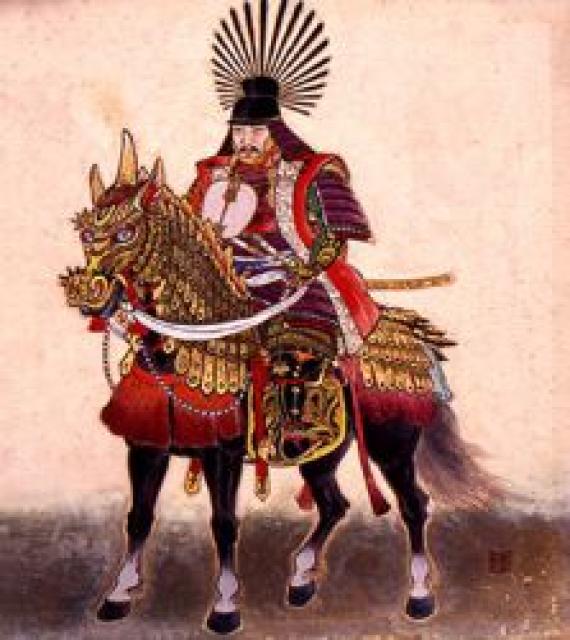
Hideyoshi Toyotomi
 Japan
JapanBiography of Hideyoshi Toyotomi
Hideyoshi Toyotomi is a renowned Japanese military and political figure who played a crucial role in the unification of Japan. He was born in a peasant family in the Owar province (modern-day Aichi prefecture) in 1536. As a young man, Hideyoshi aspired to become a samurai and served several military leaders before joining the future ruler of Owar, Oda Nobunaga, in 1554. Nobunaga recognized Hideyoshi's intelligence and brilliance and promoted him to the rank of general.
Some of Hideyoshi's notable achievements include the rapid construction of Sunomata Castle in one night in 1566, providing rear defense in the Battle of Kanegasaki in 1570, and the "water assault" on Takamatsu Castle in 1582. After Nobunaga's death in 1583, Hideyoshi seized power and unified the fragmented "states" of Japan under his leadership by 1591. He implemented a nationwide land survey that served as a basis for taxation for the next three centuries and enforced the confiscation of weapons from peasants and merchants, dividing Japanese society into military administrators and civilian subordinates.
In the latter part of his rule, Hideyoshi banned Christianity in Japan in 1587 and engaged in aggression against Korea and China from 1592 to 1598. He passed away in 1598, leaving behind his young son, Hideyori. Hideyori, the future ruler of Japan, was born into a peasant family in the Yamano village in the Owar province (now Aichi prefecture). The exact date of his birth is unknown, with scholars suggesting either February 2, 1536 (5th year of Tenbun) or March 26, 1537 (6th year of Tenbun). Hideyori's father's lineage is also poorly documented, with some claiming he was a simple peasant and others speculating he was from a lower-ranking samurai class.
After his father's death, Hideyori's mother remarried. Due to the constant abuse from his stepfather, Hideyori decided to run away from home and become a samurai. Eventually, he left his homeland and headed east to the Suruga province (modern-day Shizuoka prefecture) with the intention of serving the Imagawa clan. Taking on the name Kinosita Tokitiro, Hideyori, the peasant son, managed to secure a position under samurai Matsushita Naganori, one of Imagawa's vassals. When he would later become the ruler of Japan, Hideyori rewarded his first suzerain by granting him the Kusano Castle and its surrounding rich lands.
In 1554 (23rd year of Tenbun), Hideyori left Imagawa and joined Oda Nobunaga's service as a sandal-bearer. His rapid rise through the samurai ranks began when he completed the repair of Nobunaga's collapsed fortifications in just three days. This impressed Nobunaga, who, despite Hideyori's non-aristocratic background, appointed him as the administrator of Kiyo Castle Town. Hideyori, known for his managerial abilities, was also entrusted with financial operations for the Oda clan. As he gained a high social status, the newly appointed samurai solidified it in 1564 (7th year of Eiroku) by marrying Asano Nagamasa's daughter, one of Nobunaga's vassals.
In 1566 (9th year of Eiroku), Hideyori distinguished himself during the war between Oda Nobunaga and the Saito clan for the Mino province (modern-day Gifu prefecture). He built fortifications overnight in the marshy area of Sunomata, which became the main stronghold for the assault on the enemy citadel. Additionally, Hideyori managed to persuade influential enemy generals to join his side. The tide of the war turned, and within two years, Nobunaga seized the entire province. In 1568 (11th year of Eiroku), Hideyori participated in Oda's campaign to Kyoto and was appointed as a co-ruler of the capital along with Aketi Mitsuhide.
In 1570 (1st year of Genki), Hideyori joined Oda Nobunaga's army in their campaign against the Asakura clan, rulers of the northern Echizen province (modern-day Fukui prefecture). During this campaign, news of ally Adzai Nagamasa's betrayal, potentially trapping Oda's army between the enemy forces of Asakura and Adzai, emerged. Nobunaga decided to retreat rapidly to the capital, leaving Hideyori, appointed as the leader of the rearguard, to certain death. However, Hideyori successfully defended against enemy attacks in the Kanegasaki area and safely returned to Kyoto. This feat of covering the retreat of his own forces changed the perception of Hideyori from a civilian upstart to a gifted military commander.
After the destruction of the Adzai clan in 1573 (1st year of Tensho), Hideyori acquired their former territories in the northern part of the Omi province (modern-day Shiga prefecture) and became the ruler of Nagahama Castle. Since he did not have his own vassals, he recruited his own relatives, mostly peasants, to serve him. Additionally, he enlisted some of the wandering former vassals of the defeated Adzai clan as his subordinates. It was during this time that he took the name Hashiba Hideyori.
In 1575 (3rd year of Tensho), Hideyori participated in the famous Battle of Nagashino, where Oda Nobunaga's arquebusiers decimated the renowned cavalry of the Takeda clan. In 1576 (4th year of Tensho), he was appointed as an assistant to the general Shibata Katsuie, who commanded Oda's forces against the advancing Uesugi Kenshin. During the planning of the military operations, Hideyori had a disagreement with Katsuie and independently left the headquarters. Katsuie's frontal attack, which was carried out without Hideyori, failed, resulting in a crushing defeat in the Battle of Tedorigawa. When Oda Nobunaga learned about Hideyori's desertion, he intended to execute him. However, considering his potential utility in economic and military matters, he only reprimanded him severely. To atone for his wrongdoing, Hideyori was appointed as the commander of Oda's forces in a campaign against the powerful Mori clan, who controlled the Chugoku region. Over the course of 1577-1578, he managed to subdue several weak clans, such as Akamatsu, Bessho, and Kodera, and established a foothold centered around Himeji Castle (modern-day Hyogo prefecture). In 1579 (7th year of Tensho), Hideyori persuaded the Urita clan, a longstanding vassal of the Mori clan, to join his side.
However, in 1580, the Bessho clan revolted in Hideyori's rear, forcing him to temporarily suspend his Western advance and surround the rebels' castle. The enemy citadel was only taken after a year-long siege, during which Hideyori bought up all the provisions in the area. In 1581 (9th year of Tensho), Hideyori lured the remaining vassals of the defeated Yama clan, who had wandered as ronin throughout the country, to his side and captured their main fortress, Tottori Castle.
In 1582 (10th year of Tensho), Hideyori invaded the Bizen province (modern-day Okayama) and laid siege to Takamatsu Castle. This castle, situated in a valley surrounded by mountains and rivers, proved difficult to conquer. However, Hideyori constructed dams around the castle and redirected the rivers, causing the entire valley to be flooded. Due to this engineering feat and heavy rainfall, the castle turned into an island in an artificial lake. Its fall was only a matter of weeks. In May 1582, the atrocities committed by Oda Nobunaga's forces in the 33 Japanese provinces under their control led to a rebellion against Nobunaga's rule. Surrounded by a rebel army of tens of thousands in the Honganji temple in Osaka, Nobunaga committed seppuku. Hideyori, who was leading the water assault on Takamatsu Castle, learned of Nobunaga's death but kept it secret from the enemy, concluding a truce with the Mori clan and hastily rushing all his troops to the capital. Simultaneously, another close ally of Nobunaga, Tokugawa Ieyasu, also launched an attack against the rebels. However, Hideyori outpaced him, covering hundreds of kilometers in just three days. On June 12, 1582, Hideyori's 40,000-strong army, with overwhelming numerical superiority, defeated Aketi Mitsuhide's forces in the Battle of Yamazaki. Mitsuhide, who attempted to loot food and forage for his horses, was killed by local peasants.
Positioning himself as a "avenger," Hideyori gained increased influence among the samurai. At a council meeting in Kiyo Castle, where the succession of the Oda clan was decided, Hideyori secured the support of generals Niva Nagahide and Ikeda Senyu. To eliminate his potential rival, Oda Nobutaka, Hideyori persuaded him to commit suicide. Following the council's decision, Hideyori received the lion's share of Nobunaga's territories and became the regent-advisor to the new leader of the Oda clan, the three-year-old Sanboshi. The council's decisions caused dissatisfaction among Hideyori's long-time rival, Shibata Katsuie. In 1583, the rivalry between Hideyori and Katsuie escalated into armed conflict. In the decisive Battle of Shizugatake, Katsuie's forces suffered defeat and retreated to the Echizen province (modern-day Fukui prefecture). Taking advantage of the situation, Hideyori's victorious army invaded the enemy's territories and surrounded their main citadel, Kitano Castle. Katsuie and his wife Oichi committed seppuku, and the fortress fell. After this battle, opposition forces within the Oda clan surrendered to Hideyori, and he became the de facto successor of Oda Nobunaga, seizing his territories and continuing the task of bringing Japan under his rule. His greatest competitor in the process of unification was his former ally, Tokugawa Ieyasu. In 1584, both commanders clashed in the Battle of Nagakute, in which Tokugawa's samurai emerged victorious. However, Hideyori's economic and military power was so formidable that Ieyasu opted for peaceful negotiations, sending his eldest son as a hostage. Hideyori sent him back, demanding Ieyasu's personal appearance in Kyoto to acknowledge his dependency. Nevertheless, Ieyasu had no intention of relinquishing his own territories or acknowledging his vassalage. To compel Tokugawa to submit, Hideyori sent his sister Asahi as a hostage and sent his elderly mother as a hostage as well. Finally, in 1586, Tokugawa arrived in Kyoto, where he swore allegiance to the new suzerain. Thus, Hideyori solidified his position as the sole successor of Oda Nobunaga. In 1583, Hideyori built a large castle in Osaka on the foundation of the Honganji temple fortifications. According to contemporaries, no fortress in Japan, China, or Korea had such fortifications. Osaka became the main financial center and de facto capital of the country.
In the 1580s, Hideyori planned to establish a shogunate, but this plan was buried when the shogun fugitive Ashikaga Yoshiaki refused to recognize him as his son. As he could not become the supreme commander of all Japanese samurai, Hideyori decided to become the "first person" at the imperial court and govern the country on behalf of the puppet emperor.
In 1585, Hideyori received the title of regent-kampaku and in the following year, he was granted the aristocratic surname Toyotomi and the position of grand minister daidjo-dainzin, the highest rank at the imperial court. This marked the beginning of his legitimate rule as someone who, according to Japanese customs, could never have governed the country due to his plebeian background. After suppressing the Buddhist rebellions in the Ki'i province (modern-day Wakayama prefecture), Hideyori dispatched his forces to the Shikoku Island, which was under the control of local ruler Tōshōkabe Motochika. In 1584, before the war began, Tōshōkabe was offered to accept vassalage to the Toyotomi clan, surrender the central lands of the island, and receive three distant provinces in return. Predictably, Tōshōkabe refused, and Hideyori sent an expeditionary army led by his younger brother to Shikoku. The total number of invading forces exceeded 100,000, attacking from the north and east. Tōshōkabe suffered a series of defeats in battles, and finally, surrendered to his opponent. After this campaign, Hideyori conquered the rebellious Kaga province (modern-day Ishikawa prefecture) ruled by former vassal of Oda Nobunaga, Sasa Narimasa. In 1585, after the Simazu clan expanded its territories on the Kyushu Island, taking lands that belonged to Hideyori's allies, demands for Simazu's recognition of Toyotomi's supremacy were rejected, triggering intervention. The intervention was hastened by the defeat of Hideyori's allies on Kyushu and Shikoku by the Simazu samurai in the Battle of Hetsugigawa (1586).
In 1587, Hideyori personally embarked on a campaign to Kyushu, leading a 200,000-strong army. The Simazu clan could not withstand an army ten times its size and surrendered to the enemy. As a result, the entire Western Japan came under Toyotomi Hideyori's control. On the conquered lands, he prohibited the spread of Christianity in 1587 and confiscated weapons from the local population in 1588. From 1589, Hideyori planned the destruction of the Go-Hojo clan, the most powerful ruler of the Kanto region. The cause for war was the capture of a castle owned by the Hojo clan's allies, the Sanada and Suzuki clans. In 1590, Hideyori laid siege to the main citadel of the enemy, Odawara Castle, with the intention of taking it by force.
During the siege, he ordered all the rulers of Eastern Japan to appear in his headquarters to prove their loyalty. Nearly all samurai from the Tohoku region arrived at Hideyori's camp and acknowledged their dependence on him.
After three months, the enemy fortress, which prominent military leaders such as Takeda Shingen and Uesugi Kenshin had failed to conquer in the past, fell. The head of the Go-Hojo clan committed seppuku along with his sons. By 1590, Toyotomi Hideyori effectively became the sole ruler of the Japanese islands. The century-long period of internal strife and wars came to an end. The new ruler of Japan handed over the title of regent-kampaku to his nephew Hideatsu and assumed the titles of taikō (retired regent).
Hideyori continued the economic policies of his predecessor Oda Nobunaga, which emphasized free trade. He planned to implement monetary reforms by minting the first Japanese gold coin. Hideyori also compiled a nationwide land survey and secured land for the peasants who worked on it. His policy of confiscating weapons (including sickles, scythes, forks, and knives) from the civilian population contributed to the formation of a class-based society, where the military class (samurai) governed the civilians (peasants, merchants, and traders). To maintain a 200,000-strong army and a complex bureaucratic apparatus, Hideyori encouraged economic growth and promoted cultural development through patronage of the arts and construction projects.
Despite his achievements, Hideyori's rule faced challenges from rival warlords, including Tokugawa Ieyasu, who ultimately seized power after Hideyori's death. The Battle of Sekigahara in 1600 marked the turning point in the struggle for control of Japan, leading to the establishment of the Tokugawa shogunate.
Hideyori's legacy remains significant in Japanese history as a key figure in the unification of Japan and his contributions to political and economic reforms. His rise from a peasant background to a central figure in Japanese politics exemplifies the social mobility and dynamic nature of the Sengoku period.