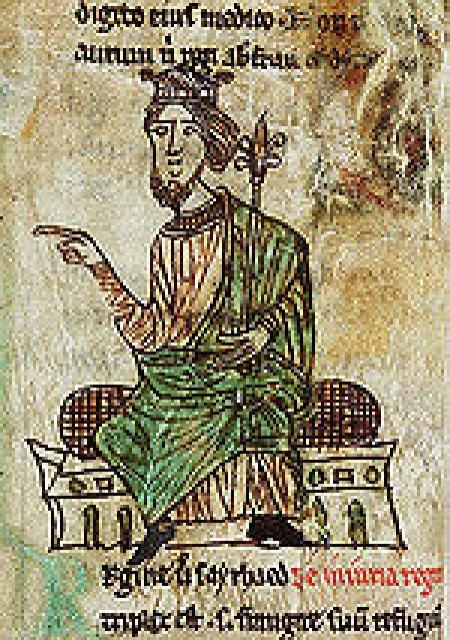
Hivel ap Kadell
 Great Britain
- Hywel's Ancestry and Rise to Power
- Unification of Wales and Peaceful Reign
- Controversial Policy and Laws
- Legacy and Recognition
Hywel's Ancestry and Rise to Power
Hywel the Good was born around 880, the younger son of Cadell, himself the son of Rhodri the Great. His family belonged to the Dinefwr branch of the ruling dynasty of Wales. In 905, Cadell conquered the kingdom of Deheubarth (Dyfed) and granted its rule to Hywel. To solidify his position, Hywel married Elen, the daughter of its previous ruler, Llywarch ap Hyfaidd.
Unification of Wales and Peaceful Reign
Upon Cadell's death in 909, Hywel inherited part of Seisyllwg. In 920, after his brother's passing, he united Deheubarth and Seisyllwg, forming the kingdom of Deheubarth. In 942, following the death of his cousin Idwal Foel, Hywel gained control of Gwynedd. At the height of his power, his realm encompassed nearly three-quarters of present-day Wales.
Hywel's reign was remarkably peaceful, attributed in part to his amicable relations with Athelstan, the ruler of Wessex. Such was their bond that Hywel even minted his own coins in the English city of Chester, making him the only Welsh ruler to do so. He studied Anglo-Saxon law and made a pilgrimage to Rome in 928, which likely influenced his ideas of governance.
Controversial Policy and Laws
Hywel's pro-Anglian stance was met with resistance from some of his subjects. Scholars speculate that the poem "Armes Prydein" ("Prophecy of Britain") was written during this time, urging Welshmen to ally with other non-English peoples against the Saxons. However, Hywel maintained a neutral stance during the Battle of Brunanburh, where Scandinavian and Celtic leaders opposed Athelstan and Edmund.
Around 945, a "parliament" convened at Whitland in Carmarthenshire to codify Welsh laws based on customary law. The renowned scribe Blegywryd was involved in their compilation. These "Laws of Hywel" remained in use in Wales until the 16th century.
Legacy and Recognition
After Hywel's death in 950, his kingdom was divided into three: Gwynedd returned to Idwal Foel's descendants, while Deheubarth was shared among Hywel's sons. However, the Laws of Hywel endured, and the University of Wales annually awards the Hywel the Good Prize in recognition of research in medieval law.




