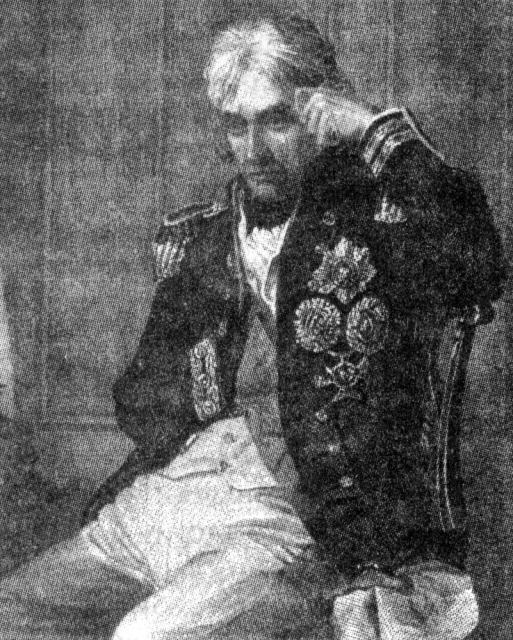
Horacio Nelson
 Great Britain
Biography of Horatio Nelson
Horatio Nelson, a renowned British naval commander, was born on September 27, 1758, into the family of a parish priest. After several years of schooling, he joined his uncle Captain Maurice Suckling's ship as a midshipman in 1771. Nelson then served on trading and military vessels in the West and East Indies, and participated in a polar expedition in 1773.
Impressively passing the lieutenant's exam in 1777 and proving himself in the war against the North American colonists, Nelson quickly rose through the ranks, becoming a brig captain in 1778 and then a frigate captain in 1779. In 1780, while participating in an operation on the San Juan River in Honduras, he nearly died from severe dysentery. From 1784 to 1787, Nelson served in the West Indies, where he married Fanny Nisbet, the widow of an Antiguan planter, in 1787. While combating smuggling, he often clashed with superiors, demanding strict adherence to the law. This earned him numerous enemies among the officials of the Admiralty. Upon his return to England, Nelson was practically removed from the fleet and lived in a village, awaiting a new appointment for five years. It was only with the beginning of the war against France in 1793 that Nelson was given the position of captain of a ship of the line in the Mediterranean fleet.
In 1793, he actively participated in actions near Toulon and in 1794, he commanded a landing party in Corsica, losing his right eye during the siege of the Calvi fortress. On July 13, 1795, he distinguished himself in a naval battle, forcing a French ship, which greatly surpassed his own in power, to surrender under his personal command.
Nelson's fame as a national hero came after the battle on February 14, 1797, off Cape St. Vincent, the southwesternmost tip of Portugal. He took the initiative to maneuver his ship out of the line of battle and successfully defeated the Spanish fleet, which was crucial to their defeat. Two out of the four Spanish ships captured by the English were taken by boarding under Nelson's personal command. He was awarded the Order of the Bath and the rank of rear admiral for this battle. In July 1797, during an unsuccessful attempt to capture the port of Santa Cruz on the island of Tenerife, Nelson lost his right arm.
In May 1798, a storm scattered his fleet, preventing him from preventing Napoleon Bonaparte's Egyptian expedition from leaving Toulon. Chasing after them, Nelson discovered the enemy fleet in the Bay of Aboukir (mouth of the Nile). Here, he successfully implemented a groundbreaking tactic for the time, which involved attacking a portion of the enemy's superior forces and then overwhelming the rest to destroy them. On August 1, at sunset, he engaged 10 line-of-battle ships against 13 French ships, which were anchored and protected by coastal artillery. Throughout the night-long battle, Nelson captured and destroyed 11 French ships without losing a single one of his own. The army of Napoleon, trapped in Egypt, was doomed. In reward for his victory, George III made Nelson a baron of the Nile and Burnham Thorpe.
In Naples, where Nelson brought his ships for repairs after Aboukir, his famous affair with Lady Emma Hamilton, the wife of the British ambassador, began and continued until the admiral's death. It was later extensively depicted in literature. In 1799, Nelson assisted King Ferdinand IV of the Two Sicilies in suppressing the Neapolitan revolution and, in gratitude, was granted the title of Duke of Bronte.
Upon his return to England, Nelson was promoted to vice admiral in 1801 and appointed as the second-in-command of the Baltic fleet, which was directed against the Scandinavian powers. On April 2, 1801, he set fire to the Danish fleet in the harbor of Copenhagen. For this victory, Nelson was granted the title of Viscount. In 1803, after the resumption of war with France, he took command of the British Mediterranean fleet. For two years, he chased the elusive enemy, who evaded a general battle. It was only on October 21, 1805, at Cape Trafalgar (north of Gibraltar), that he encountered the combined forces of the Spanish and French fleets, and, once again, he rejected the outdated line tactic to decisively defeat them. Nelson was mortally wounded in this battle. His body was brought to London, and on January 9, 1806, he was buried with great ceremony in St. Paul's Cathedral. Reports and letters of Nelson were first published forty years later in 1845, and his final diary was recently published in 1971.


