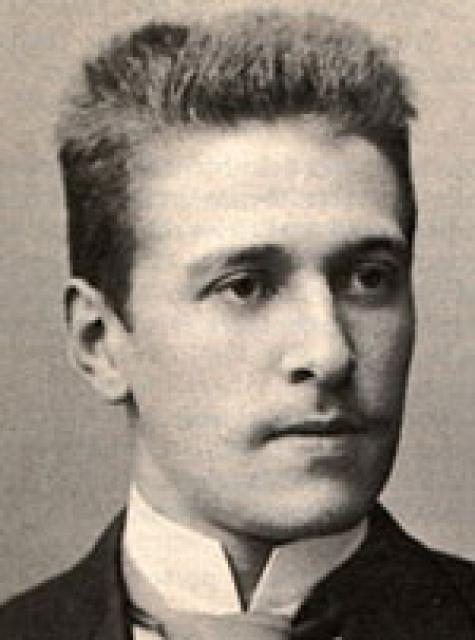
Hugo Hofmannsthal
 Austria
Hugo von Hofmannsthal Biography
Hugo von Hofmannsthal was an Austrian poet, playwright, novelist, and essayist. He remarkably reached literary maturity at an early age and was already recognized as a master by the age of twenty-five. His early dramatic works were characterized by their universality, depth, and plasticity of expression. Tending towards symbolism, they sharply stood out against the prevailing naturalistic theater of the time.
Hofmannsthal studied law at the University of Vienna. He participated in World War I, while maintaining the belief in its destructive nature for Austria. In July 1929, his eldest son tragically took his own life, and just a few days later, on July 15th, 1929, Hofmannsthal himself passed away.
Hofmannsthal remarkably reached literary maturity at an early age and was already recognized as a master by the age of twenty-five. His early dramatic works were characterized by their universality, depth, and plasticity of expression. Tending towards symbolism, they sharply stood out against the prevailing naturalistic theater of the time. Among his early plays, the most significant ones are "Der Tod des Tizian" (The Death of Titian, 1892), "Alkestis" (Alcestis, 1895), and "Das Bergwerk von Falun" (The Mine of Falun, 1899). His play "Elektra" (1903) was used by Richard Strauss as the libretto for the opera of the same name (1906), and their collaboration led to the creation of operas such as "Rosenkavalier" (1911), "Ariadne auf Naxos" (1912), "Die Frau ohne Schatten" (1919), and "Arabella" (1933).
The post-war changes were perceived by Hofmannsthal as a serious threat to European cultural heritage. In an effort to resist these changes, he co-founded the annual Salzburg Festival with Max Reinhardt. The pinnacle of Hofmannsthal's drama is the play "Der Turm" (The Tower, 1923; revised edition 1927). Hofmannsthal's work as a literary critic, translator, and author of comedies, including "Der Schwierige" (The Difficult Man, 1921), is characterized by exceptional versatility. His correspondence with Richard Strauss was published in 1926.