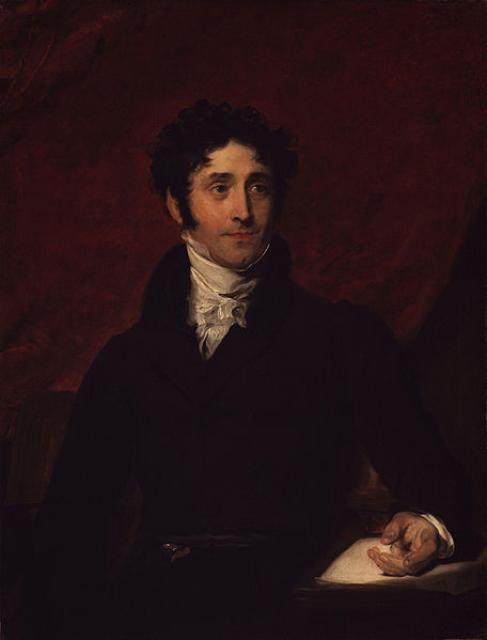
Thomas Kempbell
 Great Britain
Biography of Thomas Campbell
Thomas Campbell was a Scottish poet, best known for his sentimental works on the affairs and destinies of humans. He was also one of the initiators of the project that led to the creation of the University of London.
Early Life
Thomas was born in Glasgow, Scotland, into the Campbell family of Kirnan. His father, Alexander Campbell, worked in a trading firm but lost most of his fortune after the American Revolution. Thomas completed his schooling in Glasgow and enrolled in the local university. Even as a student, he demonstrated remarkable poetic abilities, winning prizes for his knowledge of classical literature, arts, and his skills in writing poetry. In his free time, Campbell worked as a tutor.
Writing Career
In May 1797, Thomas traveled to Edinburgh to attend law lectures. He supported himself through teaching and writing poetry, with the assistance of Robert Anderson, the editor of 'British Poets.' In 1799, he published his most famous work, 'The Pleasures of Hope,' which addressed various topical issues such as the French Revolution, the partition of Poland, and the oppression of black people. The success of 'The Pleasures of Hope' was immense.
Travels and Later Life
In June 1800, Thomas embarked on a journey abroad without a specific purpose. After a meeting with Gottlieb Friedrich Klopstock in Hamburg, he was arrested by the French in Regensburg. Campbell managed to escape his captors and sought refuge in a Scottish monastery. Although the trip seemed futile, it was during his travels in Germany that he wrote some of his most famous poems. He spent the winter in Altona, where he met Anthony McCann, an Irishman whose story later inspired 'The Exile of Erin.'
Around this time, Campbell began contemplating the creation of an epic work about Edinburgh, which he intended to title 'The Queen of the North.' However, the onset of the Anglo-Danish War compelled him to return home. Back in Scotland, he met Gilbert Elliot-Murray-Kynynmound, with whom he became the personal secretary. In 1803, Campbell married his cousin Matilda Sinclair and settled in London. Although well-received among the Whigs, this friendship did not offer any substantial practical benefits. It was only in 1806 that Campbell began receiving a government pension of £200 per year. He earned a living through his literary work and occasional journalism.
In 1812, Campbell delivered a series of lectures on poetry at the Royal Institution of London. Walter Scott subsequently invited him to head the literature department at the University of Edinburgh. Alongside teaching, Campbell continued to collaborate actively with the British Poets Society and publish new works of varying degrees of success. Campbell played a significant role in the creation of the University of London, visiting Berlin to study the German education system and providing Lord Brougham with valuable advice. From 1826 to 1829, he served as the rector of the University of Glasgow.
In 1828, Campbell's wife passed away, and his own health gradually deteriorated. He withdrew from public life and died on June 15, 1844, at the age of 66.





