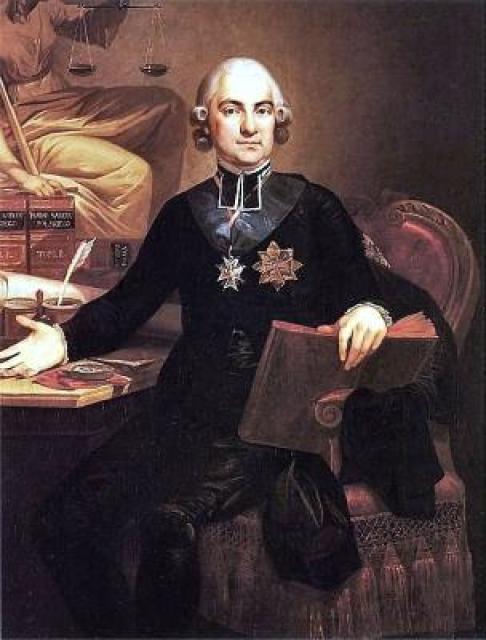
Hugo Kolontay
 Poland
Biography of Hugo Kołłątaj
Hugo Kołłątaj was a Polish publicist and social activist during the Enlightenment period. He was one of the authors of the Constitution of May 3, 1791. Born on April 1, 1750, in the noble family of Antoni Kołłątaj and Marianna Mierzeńska, he grew up in the village of Wielkie Dederkały. He received his early education in the schools of Pińczów and later studied at the Kraków Academy, which is now known as the Jagiellonian University. In 1768, he received a doctorate in philosophy.
After completing his studies, Kołłątaj became a Roman Catholic priest and spent some time in Vienna and Italy, where he familiarized himself with Enlightenment philosophy. Upon returning to Poland, he actively participated in the activities of the Commission of National Education and the Society for Elementary Books. From 1782 to 1786, he led the reform of the Kraków Academy, introducing lectures on Polish literature and natural sciences, teaching in Polish, and expanding access to education for students from the middle class. Kołłątaj also played a crucial role in managing the academy's finances and promoting progressive ideas to enhance the university's scientific level.
In addition to his educational pursuits, Kołłątaj was actively involved in politics. He gained recognition among reformist circles and, in 1779, moved to Warsaw, where he led an unofficial group of satirists, philosophers, and publicists known as "Kołłątaj's Forge." They critically examined the outdated political and social structures of the Polish Commonwealth. As a leader of the patriotic party, he outlined his program in the "Several Anonymous Letters" to Marshal Stanisław Małachowski from 1788 to 1789 and in "The Political Law of the Polish Nation" in 1790.
Kołłątaj was awarded the Order of Saint Stanislaus in 1786 and became a Knight of the Order of the White Eagle in 1791. He actively participated in the creation of the Constitution of May 3, 1791, and founded the Assembly of Friends of the Government Constitution to assist in its adoption. From 1791 to 1792, he held the position of Crown Vice Chancellor. During the Russo-Polish War of 1792, which occurred after the first partition of Poland following the adoption of the Constitution, Kołłątaj, alongside other royal advisors, convinced King Stanisław August Poniatowski to join the Targowica Confederation, formed by opponents of the Constitution and supporters of weakening Polish sovereignty.
In 1792, after the confederates' victory, Kołłątaj emigrated to Dresden, where he collaborated with Ignacy Potocki on the work "Adoption and Fall of the Polish May 3 Constitution." During his exile, his political views became more radical. In 1794, he participated in Tadeusz Kościuszko's uprising and co-authored the Act of the Uprising on March 24 and the Polaniec Manifesto on May 7, leading the treasury of the Supreme National Council and joining the left wing of Polish Jacobins. After the suppression of the uprising, Kołłątaj was imprisoned by the Austrians until 1802. However, he was released upon the request of Prince Adam Kazimierz Czartoryski and settled in Wołyń, where he co-founded the Krzemieniec Lyceum with Tadeusz Czacki in 1805. Between 1807 and 1808, he was interned by the Russian authorities due to suspicion of contacts with Napoleon. He spent his last years in the Duchy of Warsaw.
Hugo Kołłątaj died in solitude on February 24, 1812, in Warsaw, at the age of 61, after a prolonged illness. Despite being isolated from public life, he remained a patriot and worked on programs for the restoration and development of Poland. Many of his works were published posthumously.




