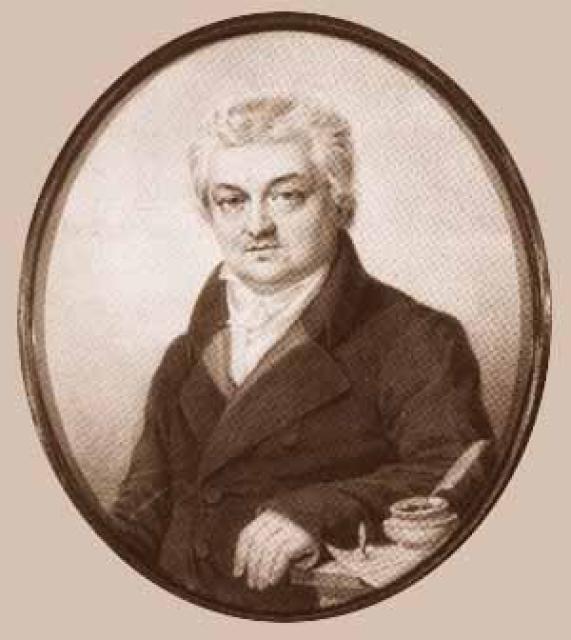
Dimitriy Buturlin
 Russia
- Early Life and Education
- Military Career
- War of the Sixth Coalition
- Napoleonic Wars and Military Historiography
- Courtier and Scholar
- Diplomatic and Administrative Roles
- Historical Writings and Retirement
- Return to Civilian Service
- The "Buturlin Committee"
- Death and Legacy
Early Life and Education
Dmitri Petrovich Buturlin was born into a prominent aristocratic family in the late 18th century. He received a thorough home education, as was customary for young gentlemen of his rank. As a youth, he frequented the estate of the renowned statesman, writer, and publisher Nikolai Ivanovich Novikov, whose proximity to Buturlin's family estate in the Moscow province may have sparked his early love for literature.
Military Career
On February 15, 1808, Buturlin enlisted as a cornet in the Akhtyrsky Hussar Regiment. Two years later, he distinguished himself in the Austrian campaign and was transferred to the Cavalierguard Regiment. However, his hopes of active service were dashed when he was assigned to the reserve squadron, despite his repeated requests for reassignment.
On March 26, 1812, Buturlin became a lieutenant in the General Staff, which had been renamed from its previous incarnation as the Quartermaster Department. He fell ill in early August and was unable to participate in the Battle of Borodino. Nonetheless, his service in various rearguard actions earned him the rank of lieutenant.
During the retreat of the French army, Buturlin pursued them all the way to Vilna, participating in the battles of Maloyaroslavets and Vyazma. For his distinction at Vyazma, he was awarded the Golden Sword and promoted back to the rank of captain in the Cavalierguard Regiment on December 24, 1812.
War of the Sixth Coalition
With the conflict extending beyond Russian borders in 1813, Buturlin played a role in the battles of Geyersberg, Kulm, and Leipzig. He sustained a wound in Leipzig, which earned him the Order of Saint Anne, 2nd class. Despite his injury, he participated in the pursuit of French forces to the Rhine and was promoted to staff captain on October 23.
Napoleonic Wars and Military Historiography
The 1814 campaign saw Buturlin serving in the allied army, where he fought in the vicinity of Troyes and the battle of Arcis, for which he received the tsar's approval. His military service concluded with the Battle of Fère-Champenoise and the Battle of Paris on March 18, during which he served as an outpost commander near Esson.
Upon the conclusion of his military career, Buturlin turned his attention to military history. His education limited his ability to express himself in Russian, leading him to compose his works in French. His first major contribution, "Campaign of 1799 in Italy," reportedly gained the attention of the renowned military theorist Henri Jomini.
Courtier and Scholar
On January 25, 1816, Buturlin was appointed adjutant to the chief of the General Staff, Prince Pyotr Mikhailovich Volkonsky. In the same year, he submitted a memo to Volkonsky outlining his strategic proposals for the defense of Russia's southern and western borders. On July 1, 1817, he became a wing adjutant and, as a captain, accompanied the emperor to the Congress of Aachen. He was promoted to colonel on March 13.
Buturlin embarked on an ambitious project to write a history of Russian military campaigns in the 18th century. He obtained permission to gather materials from the archives of the Foreign College and, in collaboration with his aide-de-camp, the well-educated officer A. Kornilovich, produced the four-volume "History of Russian Campaigns in the 18th Century," accompanied by a volume of maps. The work was originally written in French and subsequently translated into Russian by Kornilovich.
Diplomatic and Administrative Roles
Buturlin was subsequently dispatched to Spain as a military representative of Russia. For his diligent services, he was promoted to major general on January 1, 1824, and attached to the cavalry. On March 4, he was reappointed to the Quartermaster Department of the Imperial suite. On June 30, 1824, he was appointed quartermaster general of the 1st Army under the command of Count Sacken.
Buturlin spent considerable time in St. Petersburg during his tenure, corresponding with Sacken and sharing his observations on court and military affairs. He reported on the trial of the Decembrists, expressing his satisfaction with the government's firmness and desire for impartiality.
Historical Writings and Retirement
During the coronation of Nicholas I in Moscow, Buturlin received the Order of Saint Anne, 1st class. Upon his return to St. Petersburg, he requested an extension of his leave to complete his ongoing historical research. The result of his archival studies was the publication, in 1829, of the "Picture of Russia's Wars with Turkey during the Reigns of Catherine II and Alexander I," written in French and translated into Russian by F. Bulgarin.
In late 1829, Buturlin submitted his resignation and, on January 4, 1830, was dismissed from service with a pension. In August of that year, he and his family departed for Italy.
Return to Civilian Service
Upon his return, Buturlin entered civilian service. On May 14, 1833, he was renamed a privy councilor, and on May 18, he became a senator. In December 1840, he was appointed a member of the State Council, and in October 1843, he became the director of the Imperial Public Library, while retaining his previous roles.
During this period, he wrote the three-volume "History of the Time of Troubles," his only work written in Russian. On January 1, 1845, he was awarded the Order of Saint Alexander Nevsky, and the following year, he was promoted to active privy councilor.
The "Buturlin Committee"
The February Revolution of 1848 in France sent shock waves throughout Europe, prompting the Russian government to clamp down on revolutionary ideas. Buturlin became a staunch advocate of extreme measures, including the closure of universities.
Under the initiative of Baron M.A. Korf, a "Special Committee" was established to tighten censorship of Russian periodicals. Buturlin played a leading role in this committee, which became known as the "Buturlin Committee" after its chairman. The committee's task was to scrutinize all published works, identify any omissions or errors made by censors, and report their findings to the tsar.
Buturlin's actions as chairman of the committee earned him notoriety as a censorious tyrant. He proposed removing certain lines from an Orthodox hymn that condemned corrupt rulers, deeming them revolutionary. He even suggested that, if the Bible were not so widely circulated, it too would require censorship.
Death and Legacy
On April 5, 1849, Buturlin received the diamond insignia of the Order of Saint Alexander Nevsky. However, his life was cut short on October 9, and he was buried in the Dukhovskaya Church of the Alexander Nevsky Lavra.
Buturlin's military history works lacked scholarly value and have long been forgotten. However, the "Buturlin Committee" he led left an infamous mark on Russian intellectual life.