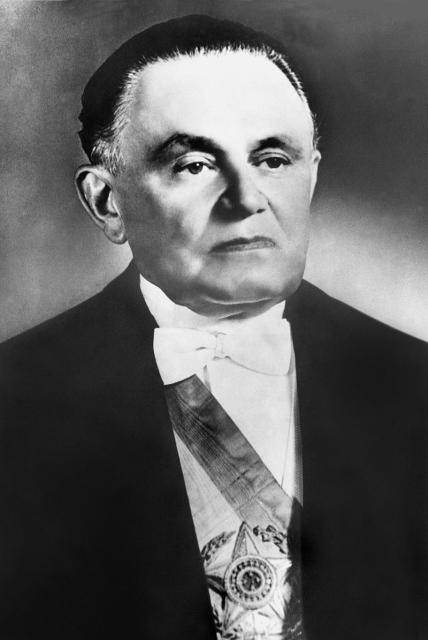
Humberto de Alencar Castello Branco
 Brazil
- Early Life and Military Career
- Rise through the Ranks
- Military Coup and Rise to Power
- Presidential Tenure
- Student Protests and Repression
- Constitutional Reform and Legacy
Early Life and Military Career
Born as the son of a high-ranking military officer, Humberto de Alencar Castelo Branco joined the army in 1918. He received eğitimini in prestigious military academies in Porto Alegre and Realengo. During World War II, he fought in the Italian campaign as part of the Brazilian Expeditionary Force (1944-1945).
Rise through the Ranks
After the war, Castelo Branco held several prominent positions within the Brazilian military, including deputy chief of the Army General Staff, commander of the General Staff School, and head of a department at the Superior War College. He later commanded the 4th Army in Recife (1962-1963) and became the Army's chief of staff (1963-1964).
Military Coup and Rise to Power
Castelo Branco was instrumental in organizing and leading the 1964 military coup that overthrew President João Goulart. He became the first president of the military regime established in Brazil, which lasted until 1985. His government focused on consolidating the new regime.
Presidential Tenure
Castelo Branco's presidency was marked by the extension of his term until March 15, 1967, and the passage of new institutional acts that expanded executive powers. He suspended the existing political parties (1965) and introduced indirect elections for the president and vice president. In 1966, he established a pseudo-two-party political system.
Student Protests and Repression
Despite student demonstrations against his regime, Castelo Branco's party won the 1966 parliamentary elections. He used congressional support to strengthen the military regime by introducing press censorship and a revised national security law.
Constitutional Reform and Legacy
On January 24, 1967, Castelo Branco promulgated a new constitution that officially took effect on March 15. On that same day, his presidential term expired. Tragically, he died in an airplane crash on July 18, 1967. Castelo Branco's legacy remains complex, with both supporters and critics of his authoritarian regime.


