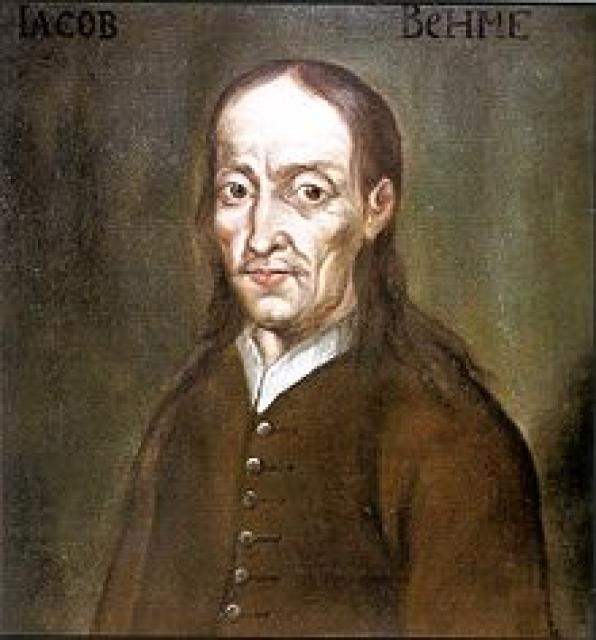
Iakov Beme
 Germany
Biography of Jakob Böhme
Jakob Böhme (1575-1624) was a German mystic and theosophist, known as philosophus teutonicus. He was born in 1575 in Alt Seidenberg, near Görlitz, to a poor peasant family. Böhme had no formal education until the age of 10. While learning the trade of a cobbler, he read mystical works by Paracelsus, particularly those of Valentin Weigel, and became acquainted with the ideas of German mystics who were critical of the orthodox Protestantism of the time.
In 1594, Böhme became a shoemaker in Görlitz and got married. After a mystical vision, which he attributed to a direct influence from the Divine, Böhme wrote his first work, "Morgenrothe im Aufgang" (later renamed "Aurora"). The attacks from the clergy further solidified his belief in his own righteousness and gained him significant fame. Within seven years, he published several more works, such as "Vom dreifachen Leben des Menschen" (1619), "Die drei Prinzipien göttlichen Wesens" (1619), "Psychologia vera, od. 40 Fragen," and "Von wahrer Buße" (1622).
To seek protection from further persecution, Böhme traveled to Dresden in 1624, where he found sympathy, even at the court. Four doctors of theology, to whom he presented his teachings, claimed that they did not understand him and therefore declined to pass judgment. Upon returning home, Böhme fell ill and died on November 24, 1624.
Despite having no formal education beyond the Bible and the writings of some mystics, Böhme independently developed a system based on the fusion of natural philosophy and mysticism. He attributed his teachings to direct divine revelation. The essential features of his doctrine included the belief in the original dualism of good and evil, which existed through three principles in the world and in God - positive, negative, and reconciling. This idea, which contained the seeds of a dialectical process, was later extracted from Böhme's mysticism and developed by German idealist philosophers. In this sense, Hegel referred to Böhme as his predecessor.
Böhme's metaphysical views were highly praised by individuals such as Schlegel, Schelling, and Hegel. His ideas also spread to England through proponents like Bromley and the Society of Philadelphians founded by Jane Lead. In France, his ideas were adopted by the well-known mystic Louis Claude de Saint-Martin.
Böhme's writings and biography provide rich material for the study of mystical experiences. Although Böhme himself did not have the intention to separate from the state church, his followers, known as Behmenists, formed the Angelic Brothers' Society, a sect that did so. In Russia, Böhme's ideas gained popularity in the late 17th century when a follower named Kulman arrived in Moscow and was burned at the stake due to the influence of Lutheran clergy. Böhme's works were highly regarded and translated into Russian in the late 18th and early 19th centuries, gaining popularity among mystics of that time.
Despite their influence and widespread distribution, only a few of Böhme's works were published during his lifetime. Later, his writings were compiled and translated into various languages. Böhme's ideas continue to captivate readers interested in philosophy and mysticism.


