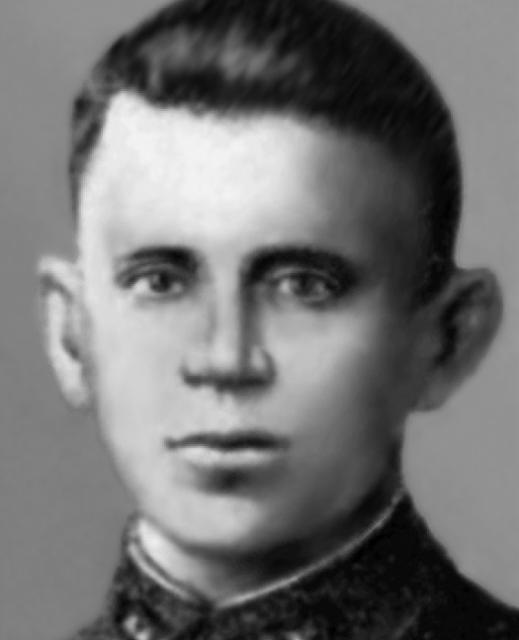
Ibrahim Berkutov
Ibrahim Berkutov was a Soviet Army sapper whose brief frontline career became closely associated with two daring engineering operations during the 1943 advance into Ukraine. In September, his platoon helped cut off German movement near the Sula River and then kept men and supplies moving across the Dnieper under sustained fire. He was named a Hero of the Soviet Union for the crossing, but was killed in battle before he could receive the award in person.
Early life and military service
Berkutov was born in 1918 in the village of Kalda, in what is now Russia’s Ulyanovsk Region. He came from a peasant family and was Tatar. After completing elementary schooling, he worked on a collective farm. He was drafted into the Red Army in 1938 and reached the front in July 1943, during the Second World War.
He served as a junior lieutenant and sapper platoon commander in the 616th Separate Sapper Battalion, part of the 337th Rifle Division of the 40th Army on the Voronezh Front. Sappers prepared routes and crossings, removed obstacles, and destroyed infrastructure that could help enemy forces maneuver. Their work often required them to operate close to opposing positions.
The Sula River operation
On September 16, 1943, as Soviet forces advanced near the village of Khoroshky in the Poltava region, Berkutov led a small group of sappers behind German lines. The group demolished a dam and a timber bridge over the Sula River. The destruction restricted German movement and reduced the possibility of a flanking counterattack against the advancing division.
Crossing the Dnieper
A week later, Berkutov’s platoon played a central role in getting the division across the Dnieper near Zarubintsy. Enemy aircraft, artillery, and machine-gun fire threatened the crossing. Working with whatever boats and materials were available, the sappers organized transport for troops, equipment, ammunition, and food to the river’s western bank, helping Soviet forces hold the Bukrin bridgehead.
The award record describes Berkutov directing the operation while standing waist-deep in the water for three days, without sleep or rest, and setting an example for his men. The crossing helped establish a foothold from which the division could reinforce its position. His actions in September—both at the Sula and on the Dnieper—made him a leading figure in his unit’s operations.
Death and recognition
On November 13, 1943, the Presidium of the Supreme Soviet of the USSR awarded Berkutov the title Hero of the Soviet Union for his role in the Dnieper crossing and the defense of the bridgehead. The decoration included the Order of Lenin and the Gold Star medal. He was killed in combat on December 4, before he could receive the recognition in person. He was buried in the village of Halepya, in the Kyiv region of Ukraine.
Berkutov’s story is remembered through the record of a frontline engineer whose work made a dangerous river crossing possible. A street in Halepya bears his name, linking his memory to the Ukrainian village where he was laid to rest.


