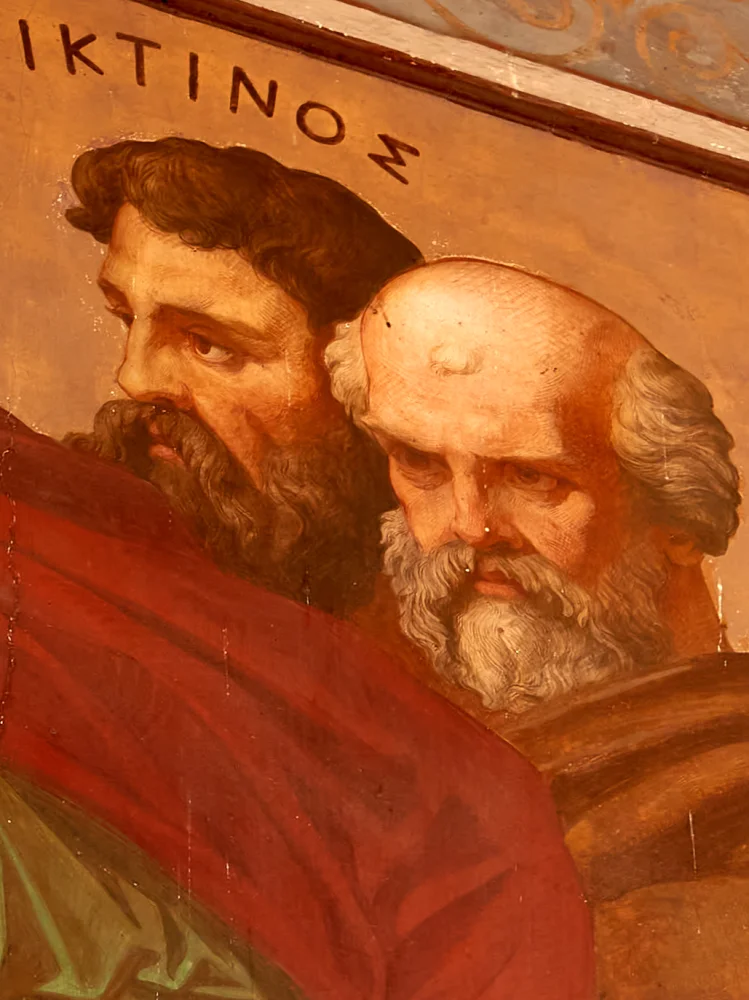
Ictinus
Ictinus was one of the architects associated with the Parthenon, the great temple that came to define classical Athens. Active in the mid-fifth century BCE, he worked during the city’s ambitious rebuilding under Pericles, when architects and sculptors reshaped the Acropolis into a showcase of Athenian power and religious devotion. His name is also linked by ancient writers to the striking Temple of Apollo at Bassae, whose design combined elements from all three principal Greek architectural orders.
The Parthenon and Periclean Athens
Little is known about Ictinus’s personal life. No secure account records his birthplace, family, or training, and the surviving evidence mainly preserves his reputation as a designer. Ancient sources associate him with Callicrates in the construction of the Parthenon, built on the Athenian Acropolis between 447 and 432 BCE. Plutarch, writing centuries later in his biography of Pericles, names both architects.
The Parthenon was dedicated to Athena, the city’s patron goddess. It stood at the heart of a broad building program that followed the Persian Wars and flourished during Athens’s political and cultural ascendancy. The temple’s balanced proportions, sculpted decoration, and commanding position made it an architectural statement as well as a sacred space. Its design is often associated with careful mathematical relationships among its dimensions, although the details of how the architects planned those proportions remain debated.
Ictinus did not design the monument alone in the modern sense of a single author overseeing every detail. Large ancient building projects involved teams of architects, sculptors, masons, and other specialists, as well as civic authorities and religious institutions. His fame reflects an ancient tradition that attached major works to named designers, but the surviving record cannot show precisely how decisions were divided among the people who built the Parthenon.
The temple at Bassae
The ancient travel writer Pausanias credited Ictinus with designing the Temple of Apollo Epikourios at Bassae in Arcadia. The temple, built in the later fifth century BCE at a remote mountain sanctuary, differs sharply in setting from the monumental buildings of Athens. Its Doric exterior surrounds an interior arrangement that includes Ionic columns and a distinctive Corinthian capital, an early known use of that order in Greek architecture.
The temple’s mixture of architectural forms, unusual north–south orientation, and elaborate sculpted frieze have made it one of the most studied sanctuaries of the classical period. Pausanias said the Arcadians chose the epithet Epikourios, meaning “helper,” in gratitude for Apollo’s aid during a plague. The building’s location and design suggest that it answered local religious needs while also expressing the skill and resources invested in the sanctuary.
Pausanias’s attribution is important, but it comes from a visitor writing centuries after the temple was built. Scholars have questioned whether Ictinus was solely responsible for the design or whether the building emerged from collaboration with local patrons and craftsmen. The connection is widely repeated in accounts of the architect, while the degree of certainty should be treated with care.
Other works and surviving evidence
Ictinus has also been connected with the Telesterion, the great hall used for the Eleusinian Mysteries at Eleusis. Ancient testimony and later scholarship associate him with a phase of the building, but its long and complex construction history makes exact attributions difficult. Roman architect Vitruvius says Ictinus and an architect named Carpion wrote a book about the Parthenon, a work that does not survive. If Vitruvius’s report is accurate, it suggests that the design was explained in writing as well as through the building itself.
No treatise by Ictinus remains, and there is no signed architectural drawing that can be confidently linked to him. His reputation rests on ancient literary references and the monuments attributed to his design. Those limits leave open important questions about his methods and the extent of his individual contribution.
Legacy
Ictinus’s historical importance is inseparable from the buildings associated with his name. The Parthenon became one of the most influential temples in the history of Western architecture, while Bassae offers an inventive and unusual exploration of Greek architectural forms. Both structures reveal the variety of religious architecture in the fifth century BCE, from the civic grandeur of Athens to a sanctuary in the mountains of Arcadia.
The image of Ictinus as a master architect survives through later authors and the enduring power of these monuments. His personal story remains largely unknown, but the works credited to him continue to invite close study of how ancient builders combined structure, ritual, civic ambition, and artistic invention.