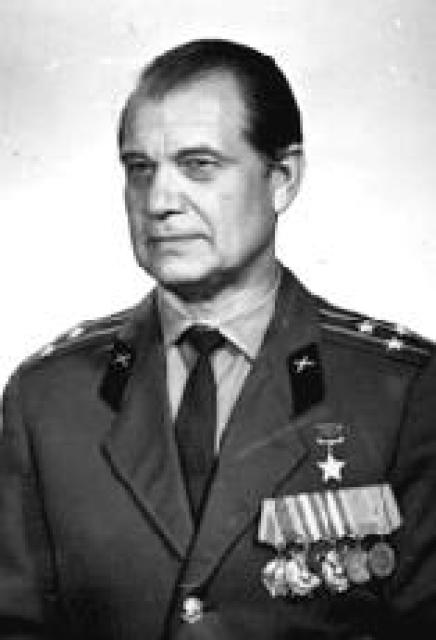
Igor Fedorchuk
 Ukraine
Biography of Igor Fedorchuk
Igor Fedorchuk was born on December 26, 1919, in the city of Slavyansk, Donetsk Oblast. His father, Alexander Georgievich (1891-1945), and mother, Anfisa Fyodorovna (1894-1992), were civil servants. In 1929, at the age of 10, Igor and his family moved to Moscow from Rostov-on-Don. After finishing high school, Igor decided to pursue a degree in economics at the Moscow Credit and Economic Institute. However, he soon realized that economics was not his calling. His heart was set on the sky.

Being near the Central Airport, Igor often watched the planes taking off from his apartment window and admired their flights. He joined an aviation club and became passionate about model airplanes. The boys from Peschanaya Street, who considered him their leader, were not surprised when they learned that Igor dropped out of college and enrolled in the Chuguev Military Aviation Pilot School. Leaving behind the institute, his beloved Moscow, and the memories of his childhood and school years in Krasnaya Presnya was difficult, but his heart longed for new adventures.

Igor was determined that his place was in military aviation. He loved flying, and he was good at it. He had confidence in himself, and his courage was unquestionable. The boys from Peschanaya Street and the pilots he lived with respected him. The demanding training in the military pilot school flew by. In July 1941, they graduated.
Thus, Igor Fedorchuk overcame the first and challenging step on the path to his future achievements. He studied aviation technology, mastered the combat aircraft, and learned the tactics of aerial combat. He excelled in advanced aerobatics. He rarely lost control of his plane, and during special training sessions, he easily recovered from a spin. Sports helped him strengthen physically, and his passion for football led him to play for the school team in volleyball. All these skills were essential for becoming a successful fighter pilot. Even before graduating from school, Fedorchuk often imagined himself face to face with the enemy in an aerial battle. He knew the German planes well, studied their combat capabilities, and mentally fought against "Junkers" and "Messerschmitts". Although his I-16, which was once the best fighter, lacked speed, Igor fearlessly attacked, utilizing the excellent maneuverability of the "Ishachok" (I-16) and performed complex aerial tricks. He always emerged victorious, seeing the wreckage of the enemy's aircraft on the ground. It was at that moment that he firmly decided to always take the initiative in battle, surprise the enemy, and attack boldly with unexpected maneuvers. "Surprise - victory", "He who is afraid is half beaten" - these principles were firmly etched in his mind and guided him on the front lines. But all this was yet to come.
After graduating, Fedorchuk was disappointed when he was assigned not to the front but to a reserve squadron. It was a blow to his ambitions. He knew he was a skilled pilot. However, the Soviet aviation was receiving new domestic and allied aircraft at that time, and it was necessary to learn how to operate them. Igor had to keep learning. He longed to be on the front lines, fighting for his beloved Moscow. Although there were combat sorties, there were no real battles where he could test his skills against the enemy one on one. However, he made valuable contributions to the overall victory through his combat sorties. But those missions seemed too mundane for a fighter pilot. He had to wait for his moment. That moment finally came in the summer of 1942 when unprecedented and fierce battles unfolded on the Stalingrad and Caucasus fronts.
In July 1942, Fedorchuk's 191st Fighter Aviation Regiment was transferred from the Kalinin Front to the Southwest Front. This was the most challenging place to be. German troops, having broken through the strategic front of Soviet forces, were heading towards the Volga River and the Caucasus passes. Their aviation dominated the skies. In this difficult situation, Fedorchuk faced the enemy in the air for the first time.
His first battle was tough, not because it was his first, but because a young and inexperienced pilot found himself in a disadvantageous position. Engrossed in chasing bombers, he did not notice when two Me-109s suddenly pounced on his "Hurricane". The Germans had the advantage in speed and vertical maneuverability. At that moment, there was no opportunity for an attack.
From the ground, people saw Fedorchuk's plane sharply dive. It seemed that he was about to crash into the ground. Perhaps the German pilots initially thought so too. Only when the Soviet pilot pulled the plane out of the dive near the treetops and started to fly away did the "Messers" turn their attention back to the pursuit. But by then, the decisive moments had passed. Igor managed to break free from the enemy, who, however, was confident that he would quickly catch up. But then, the most unexpected thing happened.
The Soviet pilot had no intention of fleeing, as the enemy might have thought. Instantly assessing the situation, he decided that if the enemy excelled in vertical maneuvering, he needed altitude. Thus, he decided to deprive them of it. Fedorchuk used what might have been the only correct maneuver in that situation. He had already mentally fought like this before.
Several minutes later, Fedorchuk's plane suddenly turned and soared towards the enemy, who did not expect such audacity. While the German pilots were focused on not crashing into the ground, Igor not only managed to keep track of the trees and fields passing beneath his wings but also caught one of the "Messers" in his gunsight. The cannons and machine guns fired, and fiery tracers streaked forward. The "Hurricane" and the "Messers" separated on converging courses. Fedorchuk saw his enemy's face up close for the first time. And when he looked back, the Me-109s were already climbing and turning towards their own forces. One of them, rapidly losing altitude, left a trail of smoke in the sky, which grew thicker and thicker...
This was not only Fedorchuk's first but also his most memorable victory in an aerial battle. He opened his score with downed enemy planes. There were three under Stalingrad. For the first enemy fighter he shot down, Sergeant Fedorchuk was awarded the "For Courage" medal.
Fighter pilots, perhaps more than anyone else in the war, changed their addresses frequently. The mail was the same, but they were already a hundred kilometers from their previous airfield. That's how Fedorchuk, in the midst of the Stalingrad battle, found himself on the Northwestern Front near Demjansk. There, heavy battles were fought to eliminate the encircled divisions of the 16th German Army by Soviet forces.
In the skies of Demjansk, it was not easy to increase the number of downed enemy planes. The small number of enemy aircraft acted cautiously. The rain and fog, and with the onset of winter, snowstorms and blizzards, limited sorties. Out of 43 combat sorties flown by Fedorchuk near Demjansk, only two resulted in face-to-face encounters with the enemy. Two encounters and two shot-down planes!
In July 1943, the 67th Guards Fighter Aviation Regiment, in which Fedorchuk served, was once again transferred, this time to the Central Front. The Battle of Kursk and Orel unfolded here. Fedorchuk's regiment became part of the Central Front. For his combat distinctions and flying skills, Fedorchuk was promoted to officer and appointed as a flight leader. Now, as a Junior Lieutenant, he commanded a formation of four fighters.
On August 2, 1943, Fedorchuk held his position within a group of 16 fighters guarding the sky above the battlefield. Below, the ground trembled from the explosions of shells and bombs, and smoke from fires blanketed the area. The ancient city of Orel could be seen ahead. Amidst the apparent chaos of tanks, vehicles, and military columns, it was clear that they were all stubbornly moving towards Orel. The Soviet troops were advancing.
At that moment, a large group of enemy planes appeared on the horizon, about 60 in number. The bombers, protected by fighters, were heading towards our troops. Fedorchuk swiftly accelerated his formation and led his four planes to intercept the enemy. He boldly dove into one of the bomber formations. Leading the attack, he set two Ju-88s on fire with his first salvo. The enemy veered off course, losing formation and retreating without completing their mission. Fedorchuk's formation suffered no losses.
The next day, another aerial battle ensued. This time, a group of German planes, consisting of up to 30 Ju-87 bombers, appeared almost simultaneously. Using the same tactic, Fedorchuk's formation aimed to overwhelm and disorient the enemy with their audacity. While chasing the bombers on their shallow dives, Igor added another shot-down aircraft to his tally.
Upon returning to the airfield, our fighters encountered a group of new German fighters, the FW-190s. But the loud publicity about the enemy's new aircraft did not intimidate the Soviet pilots. Fedorchuk led his formation on the attack against the "Focke-Wulfs". With his first salvo, he personally shot down one of the enemy planes. Overall, his formation destroyed five "Focke-Wulfs" without losing any of their own aircraft.
In the same day, during another sortie, Fedorchuk shot down another plane, this time a Ju-88. For the first time, three stars were added to the fuselage of his fighter in a single day. Not everyone accomplished such a feat!
Several more days passed. By that time, the victorious Orel Operation had concluded. Moscow celebrated with its first salute to honor the liberators of Orel and Belgorod. The front-line troops were advancing unstoppably towards Bryansk. Fedorchuk continued to provide air cover for them. He detected a group of enemy planes just as they began dropping bombs. His first thought was to do everything possible to prevent accurate bombing.
Breaking through the enemy's fighter cover, Fedorchuk, leading his formation, fiercely attacked the group of bombers. When the wreckage of one of the shot-down Ju-88s burned on the ground and the second exploded in the air, enemy fighters unexpectedly attacked his plane. This time, there was no room for accusations of oversight, as in the first battle. It was not the mistake of a novice but the selflessness of a hero. Fedorchuk had only one goal - to protect his troops from enemy bombs at any cost. At that moment, there was no place for fighter planes; they did not exist for him. And he achieved his goal. Disrupted and disoriented, the German bombers hastily turned back after haphazardly dropping their deadly cargo.
At the same time, Fedorchuk's aircraft, losing control, entered a spin. His first thought was to recover from it. But the unbearable pain in his shattered leg prevented him from doing so. He tried his best to save the plane until the last moment. However, this time, his previously obedient machine inexorably headed towards the ground. Unable to extricate himself from the cockpit, Igor pulled the parachute ring, hoping that it would pull him out of the plane. But the parachute did not open. Moreover, the pilot realized that he had forgotten to unfasten the safety harness. Mustering all his will, he managed to climb out onto the wing. The parachute jerked upward like a snake and... tangled in the tail assembly of the plane. The ground was already close by... Until the last moment, Fedorchuk held onto the wing, waiting for the parachute to fill with wind and the canopy to open. Fortunately, the canopy did open...
Soon, soldiers, who may have just been saved from death, found him. They had witnessed his battle.
The wounded pilot, with a shattered leg, was taken care of by our medics. He was first taken to a field hospital, where he underwent surgery, and then transported by plane to Lipetsk, and later to Moscow. There, experienced doctors treated Fedorchuk. The chief military surgeon of the hospital performed several more operations on his leg, which was then put in a cast. Igor spent a long time with his leg elevated, and then he learned to walk with crutches...
On February 4, 1944, an order was published in the newspaper "Pravda" announcing the award of the title Hero of the Soviet Union to those who distinguished themselves in battle. Igor Fedorchuk was awarded this highest honor.


