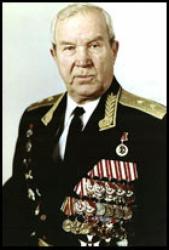
Iosif Geybo
 Ukraine
- Early Life and Military Service
- Combat Experience in the Khalkhin Gol War
- Soviet-Finnish War
- World War II
- Post-War Career
- Legacy
Early Life and Military Service
Iosif Geibo was born on April 24, 1910, in the village of Valuyskoye in the Luhansk region of Ukraine. After completing his education at the Lugansk Railway Technical School, he joined the Red Army in 1933.
In December 1934, Geibo graduated from the Kachin Flight School and was assigned to the 35th Squadron of the 56th Air Brigade near Zhitomir. He participated in the May Day air parades in Moscow in 1936 and 1937 and later served in the Far East.
Combat Experience in the Khalkhin Gol War
During the Khalkhin Gol conflict with Japan in 1939, Geibo commanded the 5th Squadron of the 70th Fighter Aviation Regiment. Flying an I-15bis biplane, he completed 25 sorties, primarily for ground attack and bomber escort missions. Geibo's squadron was later re-equipped with I-153 fighters, and he was temporarily assigned to the group of renowned Soviet ace Sergei Gritsevets.
On June 26, Geibo participated in a battle in which his regiment shot down 10 Japanese aircraft while losing three I-153s. In total, he flew 82 combat missions, engaged in 18 air battles, and claimed two solo kills and one group kill.
Soviet-Finnish War
With the outbreak of the Soviet-Finnish War, Geibo's squadron was transferred to Moscow to form a new fighter regiment, which was deployed to Karelia in late 1939. The I-153 biplanes were used for reconnaissance, patrol, and bomber protection. During the "Winter War," Geibo achieved at least four victories, including the downing of a Finnish Bristol Blenheim bomber on February 28, 1940.
World War II
The beginning of the war with Germany in 1941 found Geibo serving in the 46th Fighter Aviation Regiment, equipped with I-16 fighters. He distinguished himself in the early days of the conflict, claiming a Ju-88 bomber on June 22 and another German aircraft (type unknown) the following day.
In August 1941, his unit transitioned to the LaGG-3, but after claiming two victories (a Ju-88 and an Me-109) on August 18, he was wounded and hospitalized until December. Upon his recovery, he was promoted to Major and took command of the 20th Fighter Aviation Regiment, which was based near Moscow and equipped with the new Yak-1 fighters.
In 1942, Geibo was sent to the Chkalov Aviation School for retraining. He then assumed command of the 263rd Fighter Aviation Division. In early 1944, he was promoted to Colonel and took command of the 309th Aviation Division.
Geibo's front-line service was interrupted until October 1944, when he was given command of the 6th Guards Fighter Aviation Division, which he subsequently led through Romania, Hungary, and Czechoslovakia.
Post-War Career
After the war, Geibo continued to serve in the Soviet Air Force. He graduated from the Military Academy of the General Staff in 1949 and was elected as a deputy to the Supreme Soviet of the Moldavian SSR. He retired from military service in 1968 with the rank of Major General of Aviation.
Geibo moved to the city of Kuibyshev (now Samara) and wrote an autobiographical book titled "The War Began in the Twentieth Minute." He was awarded numerous orders and medals, including two Orders of Lenin, three Orders of the Red Banner, the Order of Kutuzov (2nd class), the Order of the Patriotic War (1st class), and the Order of the Red Star.
Legacy
Iosif Geibo was a highly decorated fighter pilot who participated in three wars and claimed 12 aerial victories. He was a role model for young pilots and a respected commander. Geibo's bravery and military achievements continue to inspire generations of aviators.