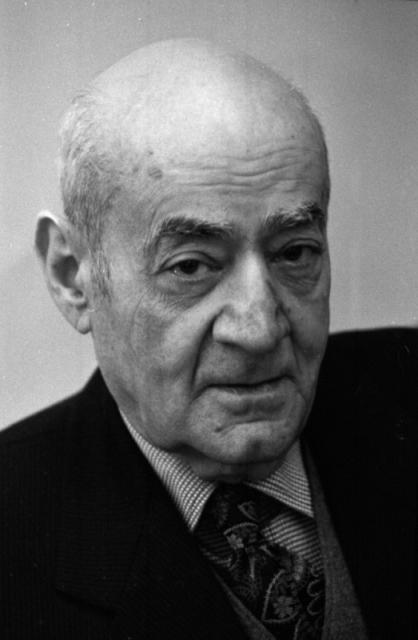
Iosif Sumbatashvili
 Georgia
Biography of Iosif Sumbatashvili
Iosif Georgievich Sumbatashvili (born October 10, 1915) is a Georgian and Russian theatrical artist. He was born in Tiflis (now Tbilisi, Georgia) and studied at a construction technical school. Sumbatashvili later graduated from the painting faculty of the Tbilisi Academy of Arts.
Early Career
In 1942, Sumbatashvili became the chief artist of the Paliashvili Opera and Ballet Theatre. He was invited to the Mardjanishvili Theatre to design the play "David the Builder" by L. Gotua, directed by V. Tabliashvili. His sketches received high praise from S. Virsaladze, the chief artist of the Rustaveli Theatre.
Work in Georgia
Over the next 12 years, Sumbatashvili designed a number of productions on various stages in Georgia. These included the opera "Daisi" by Z. Paliashvili at the Tbilisi Opera and Ballet Theatre, directed by V. Tabliashvili; "Medea" by Euripides at the Mardjanishvili Theatre, directed by A. Chkhartishvili; "A Moneyless Person" by A. Ostrovsky at the same theater, directed by V. Tabliashvili, and others. Alongside his intensive work in the theater, he also participated in the creation of films such as "Keto and Kote," "Lurdzha Magdany," and many animated films.
Move to Moscow
In 1958, Sumbatashvili moved to Moscow to design a production of A. Arbuzov's play "The Irkutsk Story" at the Vakhtangov Theatre. In 1962, he was appointed chief artist at the Central Theatre of the Soviet Army. In collaboration with the director of this theater, L. Kheifets, Sumbatashvili created the visual concepts for productions such as "The Death of Ivan the Terrible" (1966), "Uncle Vanya" by A. Chekhov (1969), "Pavel I" by D. Merezhkovsky (1989), "Masquerade" by M. Lermontov (1992), and others. The staging of "The Death of Ivan the Terrible," which received a gold medal at the Prague Quadrennial International Exhibition of Scenography, had a strong influence on the visual concept of Russian history productions.
Later Career
Sumbatashvili worked productively at the Moscow Art Theatre (Steelworkers by G. Bokarev, directed by O. Efremov, 1973; Volokolamsk Highway by V. Shatskov, directed by V. Shilovsky, 1982; Local Wars, directed by V. Shilovsky, 1985), the Maly Theatre (The Forest Spirit by A. Chekhov, directed by B. Morozov, 1990; Tsar Boris by A. K. Tolstoy, directed by V. Beylis, 1993; The Criminal Mother, or The Second Tartuffe by P. Bomarche, directed by B. Morozov, 1994; The Feast of the Victors by A. Solzhenitsyn, directed by B. Morozov, 1995; Talents and Admirers by A. Ostrovsky, directed by V. Beylis, 1995, and others), the Kirov Academic Theatre of Opera and Ballet (Peter I by A. Petrov, directed by N. Kasatkina and V. Vasilyev, 1975, and Pushkin by A. Petrov, 1979), the Novosibirsk Theatre of Opera and Ballet (ballet Romeo and Juliet, 1972), and in Poland, Bulgaria, Saarbrucken, Leipzig, and more.
Sumbatashvili's talent, high culture, and the unity of his artistic vision are the distinctive features of his work. Two theaters played a significant role in his life and career: the Vakhtangov Theatre in Moscow (The Woman Behind the Green Door by R. Ibragimbekov, directed by Yev. Simonov, 1973; Antony and Cleopatra, directed by Yev. Simonov, 1974; The Forest Spirit by A. Chekhov, directed by Yev. Simonov, 1980; Day by Day by A. Veitler and A. Misharin, directed by Yev. Simonov, 1974; The Buff Mysteries by V. Mayakovsky, directed by Yev. Simonov, 1981, and others) and the Central Theatre of the Russian Army, where Sumbatashvili returned after working at the Maly Theatre. His appointment as the chief director by B. Morozov gave a new impetus to Sumbatashvili's creativity (Much Ado About Nothing by W. Shakespeare, 1996; The Lower Depths by M. Gorky, 1998; Othello by W. Shakespeare, 1999). Currently, Sumbatashvili is the chief artist at the Central Academic Theatre of the Russian Army.





