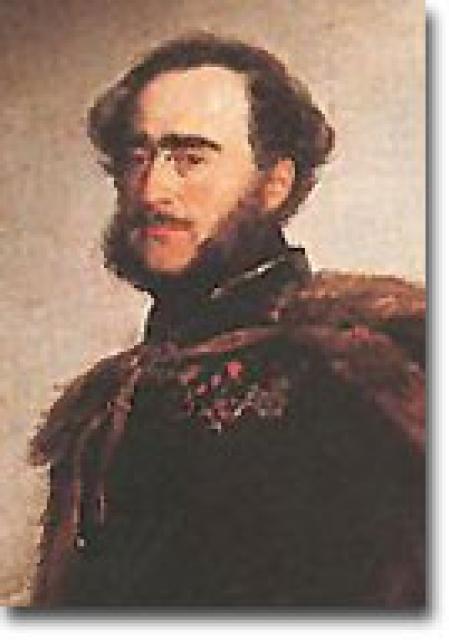
Isgtvan Secheny
 Hungary
- Hero of Hungary
- Early Life and Travels
- Founding the Hungarian Academy of Sciences
- Political Advocacy and Literary Endeavors
- Infrastructure and Technological Advances
- Moderating Influence
- Revolution and Exile
- Tragic End
Hero of Hungary
Count István Széchenyi, born into a noble Hungarian lineage, played a pivotal role in modernizing his nation. After fighting against Napoleon, he embarked on a transformative journey through Europe, witnessing the advancements that inspired him to envision a brighter future for his homeland.
Early Life and Travels
Széchenyi's family held a distinguished past, and he pursued a military career before dedicating himself to travel and intellectual pursuits. His experiences abroad exposed him to the cutting-edge developments of England and France, contrasting starkly with the stagnation he perceived in Hungary.
Founding the Hungarian Academy of Sciences
Determined to ignite progress in his country, Széchenyi donated his annual income in 1825 to establish the Hungarian National Academy of Sciences. This institution became a beacon of enlightenment, fostering scientific research and innovation.
Political Advocacy and Literary Endeavors
Széchenyi encouraged the nobility to establish clubs for political discussions, and launched a literary enterprise in 1830. Through works such as "Credit," "Light," and "Stadium," he eloquently argued for the urgent need for economic development. He criticized the aristocracy for their tax evasion and complacency, which, he believed, stifled progress.
Infrastructure and Technological Advances
Despite facing resistance from the entrenched nobility, Széchenyi's advocacy made significant strides. He paved roads, improved Danube navigation, and oversaw the construction of Budapest's first suspension bridge. These infrastructure projects enhanced connectivity and stimulated economic growth.
Moderating Influence
As Hungary entered a period of political turmoil in the 1840s, Széchenyi emerged as a less radical figure than the ascendant young generation led by Lajos Kossuth. He prioritized economic advancement over national governance, believing that freedom would follow prosperity.
Revolution and Exile
Despite his differences, Széchenyi joined Kossuth's revolutionary government in 1848. However, his political disagreements led to his resignation and eventual exile.
Tragic End
Széchenyi's scathing critique of Austrian rule in 1859 drew persecution. Broken by the ensuing legal battles, he committed suicide in 1860, leaving behind a legacy of transformative contributions to his beloved Hungary.


