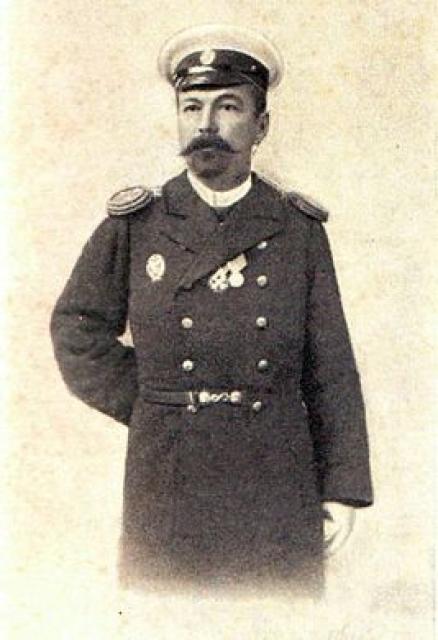
Ishak Islyamov
- Early Life and Naval Career
- Exploration and Hydrography
- Russo-Japanese War and Military Service
- Franz Josef Land Expedition
- Later Life
Early Life and Naval Career
Born on June 27, 1865, in Kronstadt, Russia, to a Tatar father, Ismail Islamov joined the Imperial Russian Navy in 1885 after completing his education in the "Marine Technical School." He was commissioned as a sub-lieutenant in the Corps of Naval Navigators and assigned to the "1st His Imperial Highness Grand Admiral Konstantin Nikolaevich Crew."
In 1887, Islamov embarked on a three-year circumnavigation aboard the clipper "Razboynik." Upon his return in 1890, he graduated from the Hydrographic Department of the "Nikolaevsky Naval Academy" and began participating in maritime expeditions as a hydrographer.
Exploration and Hydrography
In 1897, Islamov participated in an expedition to study the Kara-Bogaz-Gol bay in the Caspian Sea. In 1899, he joined the historic voyage of the icebreaker "Yermak" to Spitsbergen, where he conducted meteorological and hydrographic observations. His work on the expedition was published in a book and an article in "Zapiski po Gidrografii."
Russo-Japanese War and Military Service
During the Russo-Japanese War of 1904-1905, Islamov served on the battleship "Sevastopol" in Port Arthur as Senior Navigation Officer. He was decorated for bravery. From 1910 to 1911, he commanded the gunboats "Vikhr" and "Shkval" on the Amur River. In 1912, he was promoted to Captain 1st Rank and became head of the naval base in Khabarovsk.
Franz Josef Land Expedition
In 1914, Islamov led a western relief expedition to the Franz Josef Land archipelago to search for missing expeditions led by G.L. Brusilov, G.Y. Sedov, and V.A. Rusanov. His team, consisting of four vessels, included the first use of polar aviation in exploration.
Islamov's ship, the bark "Eklips," raised the Russian flag on abandoned Unity Island and declared the archipelago a Russian territory. The expedition also discovered a message left by Brusilov's survivors, Alhanov and Konrád, on Jackson Base on Cape Flora.
Later Life
In 1917, Islamov retired from military service as a Major General of the Hydrographic Corps. He participated in the Civil War as a member of the White Army. From 1919 until his death in 1929, Islamov lived in Constantinople, where he served as head of the Hydrographic Section of the Russian Naval Base and compiled a dictionary of Tatar roots in the Russian language. His son, Yakov, perished in 1926 during an early transatlantic aviation flight.


