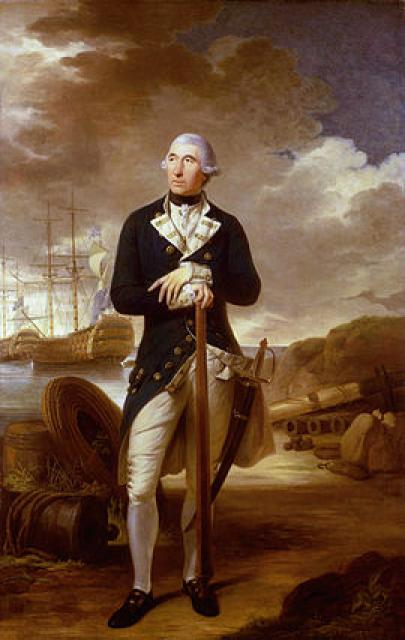
Richard Kempenfelt
 Great Britain
- Early Life and Naval Career
- Flag Captain and Signal Developer
- Fleet Command and Promotion
- Aggressive Commander and Battle of Ushant
- Religious Interests and Signal Innovation
- Tragic Death
Early Life and Naval Career
Richard Kempenfelt was born into a family of Swedish military officers who served under British rule. As a young man, he joined the British Navy and rose through the ranks, becoming a lieutenant in 1741. During the War of Jenkins' Ear, he served in the West Indies.
Flag Captain and Signal Developer
In 1757, Kempenfelt became a captain and served as a flag captain in the West Indies under the command of Admiral George Pocock and Samuel Cornish. In 1779, he developed a new book of signals for the British Navy.
Fleet Command and Promotion
In 1779, Kempenfelt was appointed flag captain to Admiral Charles Hardy, commander of the Channel Fleet. After Hardy's death in 1780, he continued to serve in that capacity under Admiral Francis Geary. In the same year, he was promoted to rear-admiral of the blue squadron and became third in command of the Channel Fleet.
Aggressive Commander and Battle of Ushant
During the American Revolutionary War, Kempenfelt proved to be a daring and aggressive commander. In 1781, he led a squadron of 12 ships to intercept a French convoy escorted by 19 ships under the command of Comte de Grasse. He managed to engage the enemy and capture several merchant and naval vessels.
Religious Interests and Signal Innovation
Outside of his naval career, Kempenfelt was deeply invested in evangelism and penned several religious hymns. In 1782, he released a new book of signals based on the French system.
Tragic Death
On August 29, 1782, the 100-gun ship "Royal George" under Kempenfelt's command capsized and sank in Spithead harbour. The admiral and most of the crew perished in the disaster.


