Ivan Bolotnikov
 Russia
- The Life and Rebellion of Ivan Bolotnikov
- The False Dmitry and Bolotnikov's Rise
- The Rebellion Gains Momentum
- The Siege of Moscow
- Internal Divisions and the Tsar's Victory
- The Siege of Kaluga
- The Siege of Tula and Bolotnikov's Capture
The Life and Rebellion of Ivan Bolotnikov
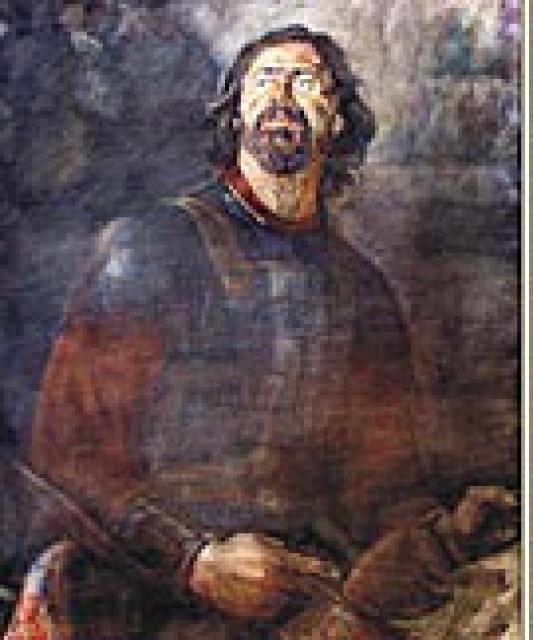
Early Life and CaptivityIvan Bolotnikov, a prominent leader during Russia's Time of Troubles, was a serf of Prince Telyatevsky. As a child, he was captured by Tatars, sold to Turks, and enslaved on Turkish galleys. Upon his release, he traveled to Venice and eventually returned to Poland.
The False Dmitry and Bolotnikov's Rise
In Poland, Bolotnikov encountered Grigory Molchanov, a pretender claiming to be the escaped Tsar Dmitry. Molchanov entrusted Bolotnikov with a letter to Prince Shakhovsky, the governor of Putivl. Shakhovsky granted Bolotnikov command of 12,000 troops.
Bolotnikov's troops spread rumors that he had met Dmitry, who had appointed him commander-in-chief. Tsar Vasily Shuisky sent a force led by Prince Yury Trubetskoy to crush the rebellion, but Trubetskoy retreated after facing Bolotnikov's army.
The Rebellion Gains Momentum
Bolotnikov's victory inspired revolts in numerous cities, which sent reinforcements to his army. Serfs and peasants rose up against their landlords and joined Bolotnikov's ranks. The Mordovian people rebelled, hoping to break free from Moscow's control. Bolotnikov was also joined by Istoma Pashkov's militia, the Lyapunov brothers, and a Cossack force from Lithuania.
The Siege of Moscow
Bolotnikov's army advanced towards Moscow, gaining support from towns along the way. Only Kolomna resisted, but was looted and burned. Near the village of Trinity, Moscow's army under Prince Mstislavsky retreated from Bolotnikov before engaging in battle.
On October 22, 1606, Bolotnikov established a camp at Kolomenskoye, just seven miles from Moscow. He sent out letters to the city and other towns, inciting the people against the wealthy and noble, and urging them to support the rightful heir, Dmitry.
Internal Divisions and the Tsar's Victory
Within Bolotnikov's army, divisions arose between nobles and landowners on one side, and serfs, Cossacks, and commoners on the other. Bolotnikov led the latter, while Istoma Pashkov and the Lyapunov brothers commanded the former.
These conflicts led to the defection of the Lyapunovs and then Istoma Pashkov to Shuisky's side. Meanwhile, Shuisky strengthened Moscow's defenses and received reinforcements from cities that supported him.
After several successful attacks on Bolotnikov's camp, the rebels retreated from Moscow. Bolotnikov fortified himself in Kaluga, where he gathered 10,000 fighters and prepared for a long siege.
The Siege of Kaluga
Shuisky sent troops to besiege Kaluga, commanded by Prince Mstislavsky. Despite frequent attacks and the defeat of a rebel force led by Prince Masalsky, Bolotnikov's resolve remained strong.
However, the absence of the named Dmitry troubled Bolotnikov. A new pretender emerged among the Cossacks, assuming the name of Tsarevich Peter. Prince Shakhovsky used this figure to rally support for the rebellion, sending him to Tula.
The Siege of Tula and Bolotnikov's Capture
Tsar Vasily Shuisky's army of 100,000 men besieged Tula in June 1607. After a prolonged siege, food ran out in Tula, and negotiations began. Shuisky promised mercy to Bolotnikov and Shakhovsky.
On October 10, 1607, Bolotnikov surrendered and was taken before Shuisky. After pleading for mercy, he was imprisoned in Kargopol, where he was blinded and later drowned.