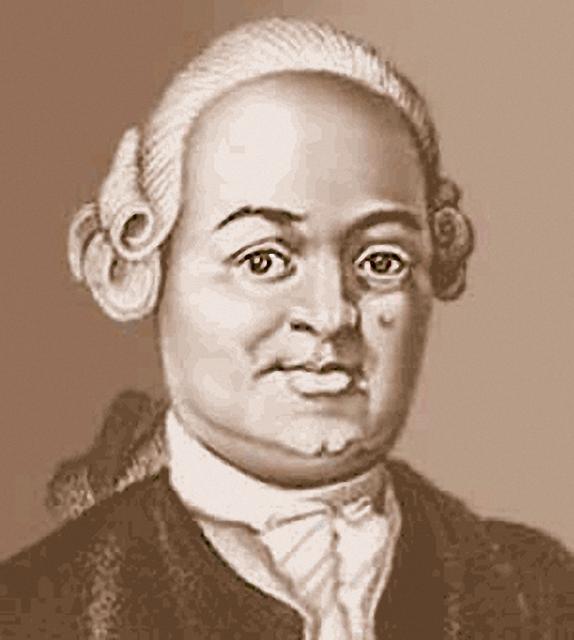
Ivan Schumacher
 Germany
Biography of Ivan Shumacher
Ivan Shumacher, a French and Russian scientist of German descent, was born in Colmar, Alsace, in 1690. He received his education at the University of Strasbourg. In 1714, he was invited by Le Fort to come to St. Petersburg, where he became the secretary of the medical chancellery and the librarian of the Petersburg Library, which later became part of the Academy of Sciences.
In 1721, Peter the Great sent Shumacher to France, the Netherlands, and England with the task of "seeking the invitation of various scholars to Russia" (including the philosopher Wolf), presenting the Caspian Sea map compiled by Messerschmidt to the Paris Academy, acquiring new books for the library, and investigating perpetual motion, among other things. Upon his return from this trip, which greatly contributed to our connections with foreign scholars, Shumacher presented a collection of books he had acquired (517 titles) and an extensive report that provided insight into Peter's views on science and enlightenment.
Shumacher was supported by Blumentrost, the president of the newly established Academy of Sciences, who appointed him as the secretary of the academy and entrusted him with the management of the library and art chamber. In 1728, he granted Shumacher full authority over the academy, which at that time had no printing press or other institutions related to arts and crafts. Shumacher took great interest in organizing these institutions.
However, he soon aroused dissatisfaction among the academicians. Despite this, he continued to act autonomously, even portraying academy members in an unfavorable light. As a result, some of them, such as Herman, Bilfinger, and Bernoulli, quickly left St. Petersburg. Starting in 1732, Miller also became a target of Shumacher's persecution and was forced to embark on a journey to Siberia.
Baron Korff, who succeeded Blumentrost in 1734, not only allowed Shumacher to continue his dominance, but also made him an advisor and entrusted him with the management of all the academy's funds. Later, in 1755, Baron Korff called Shumacher an "unlearned parasite and a bureaucratic despot."
In 1742, a commission of inquiry was formed due to complaints about Shumacher's "autocracy" and embezzlement of public funds. Shumacher, supported by some courtiers, was found guilty only of embezzling state-owned alcohol and was ordered to pay 109 rubles. He was then returned to the academy and granted the title of State Councillor as compensation for the "unjust suffering" he had endured.
With the appointment of K.G. Razumovsky as the president of the Academy of Sciences in 1746, Shumacher formed a close relationship with the latter and continued to hold a dominant position in the academy, sometimes yielding only to Lomonosov. In 1757, Lomonosov and Taubert were appointed to "attend" the academic chancellery, replacing the "weakened" Shumacher, who was soon retired. Shumacher's administration, especially during the early years of the Academy of Sciences, greatly hindered its proper development.
Under his close supervision and efforts, the following works were published: "The Chambers of the St. Petersburg Academy of Sciences, Library and Art Chamber" (1741); "Museum imperiale petropolitanum" (1741-1745). During his time, from 1742 to 1747, the Academy of Sciences published its first detailed catalog of books in its library, which was meticulously described by Sobolevsky in "Russian Bibliography Literature" by Gennadi (St. Petersburg, 1858). Shumacher's letters to Kirilov, Blumentrost, and others were published in "Materials for the Compilation of the Atlas of the Academy of Sciences in 1745," edited by Svenske in 1866.
References:
- P. Pekarsky "Science and Literature during Peter the Great's Reign" (St. Petersburg, 1862-63)
- P. Pekarsky "History of the Academy of Sciences" (Vol. I, St. Petersburg, 1870)


