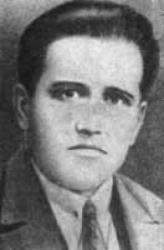
Ivan Sereda
 Ukraine
Biography of Ivan Sereda
Ivan Pavlovich Sereda was born on July 1, 1919, in a Ukrainian family in the village of Aleksandrovka in the Donbass region. He grew up in Galitsynovka, located in the same Mariinsky District. From an early age, Ivan showed strength and agility, mastering all the skills of rural work. However, he chose a slightly unusual profession for himself - he became a student at a culinary educational institution in Donetsk.
In the autumn of 1939, Ivan received a military draft notice and continued to apply his profession in army conditions. He entered World War II as a cook in the 91st Tank Regiment, part of General Lelyushenko's corps, which was fighting on the northwest front. After retreating from Daugavpils, captured by Manstein's forces, the tank division, including Ivan Sereda's regiment, took up defense east of the city. It was only the ninth day of the war, and the battles hardly ceased.
During an attack by German tanks, Ivan stayed near his field kitchen while the infantry was sent to support the tank crews. Ivan prepared lunch alone. Unbeknownst to him, two Czech-designed PzKpfw38(t) tanks decided to follow a forest path, possibly attracted by the smoke coming from the field kitchen. Sensing their approach, Ivan moved the horses further into the woods and initially planned to hide himself, but then he decided to arm himself with an axe and stay nearby, hoping that the tanks would pass by. The first tank indeed continued moving, but the second one drove straight into the trap.
From the top of the tank, Ivan jumped onto the roof and the surprised German tank crew closed the hatch. Ivan covered the viewing slits with a tarpaulin that was attached to the tank. The crew started shooting from the machine gun, but it was impossible to hit Ivan on the roof. Ivan struck the machine gun barrel with the axe, silencing the weapon. He then began pounding on the tank's hull and loudly shouting, imitating the presence of a large number of people. This was made easier by the fact that the only weapon inside the tank was the commander's Parabellum pistol, and the standard MP40 submachine guns were mounted on top of the armor.
When the crew was sufficiently stunned by the noise, Ivan, armed with a captured German submachine gun (according to other sources, a rifle), waited for the hatch to open. Under the threat of the gun, the German tank crew members exited one by one and tied each other up. The noise attracted the attention of the soldiers from a nearby infantry unit. Arriving at the scene, they saw four bound German tankers and Ivan Sereda, holding them at gunpoint.
After this event, the commander of the tank regiment appointed another soldier as the cook and sent Efreitor Sereda to the commander of the reconnaissance unit. The war situation remained intense, and a few days later, Ivan Sereda had to fight another tank. This time, he found himself behind enemy lines, and their reconnaissance group was suddenly attacked by the Germans. Armed with RGD-33 grenades, Ivan managed to approach the German tank and destroy it. But the battle continued, and a machine gunner from the group was killed. The brave Efreitor took his place. With the machine gun, he managed to hit about ten fascist motorcyclists and turn the enemy into retreat. The reconnaissance group returned with victory and significant spoils, including captured motorcycles and three prisoners.
For his bravery, in late August 1941, Ivan Sereda was awarded the title of Hero of the Soviet Union, the Lenin Order, and the Gold Star. The awards were presented to him while he was recovering in the hospital from a severe injury. The hero cook's axe remained in the regiment as a battle memento.
After recovering, Ivan Pavlovich served as the commander of a rifle platoon near Leningrad, and during the battles near Moscow, he was the commander of a rifle company in the 30th Army. In February 1942, he was seriously wounded. After leaving the hospital and completing training courses for command personnel, he continued his military service. In 1944, Lieutenant Sereda was sent for further education, this time to the cavalry school in Novocherkassk. After graduation, he was involved in providing food and forage supplies to the Eighth Guards Cavalry Regiment. In the spring of 1945, during the Soviet Army's offensive, he managed to organize exemplary deliveries of food and ammunition despite being cut off from supply bases.
After the war, Ivan Pavlovich was awarded the Order of the Patriotic War II degree, as well as medals for his participation in the defense of Moscow and Leningrad. After retiring, Senior Lieutenant Sereda returned to his hometown of Aleksandrovka, where he became the head of the village council. Unfortunately, the consequences of his severe injuries caught up with him, and Ivan Pavlovich passed away in the autumn of 1950 at the age of 31.