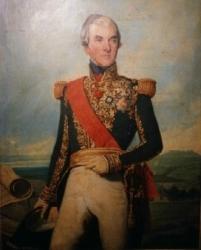
Ivan Velyaminov
 Russia
- Early Career and the Napoleonic Wars
- Service in the Caucasus and Siberia
- Literary Interests and Legacy
Ivan Velyaminov lived a life in which military command, public administration, and literary curiosity continually overlapped. A veteran of the Napoleonic campaigns, he rose to the highest infantry rank in the Russian Empire and later governed Western Siberia. Away from the field and the administrative office, he also translated Shakespeare’s Othello into Russian from a French version, a work that remained on the Russian stage for years.
Early Career and the Napoleonic Wars
Born in 1771 into a noble family from Tula province, Velyaminov was educated in the Imperial Pages Corps, a school that trained young men for service at the imperial court and in the army. In 1796 he graduated as a lieutenant in the Semenovsky Life Guards Regiment. Within a few years he had advanced to colonel and was serving in an army that would face Napoleon across Europe.
Velyaminov fought at the Battle of Austerlitz in 1805 and in the campaigns of 1806 and 1807. His conduct brought him the Order of St. George, Fourth Class, and a gold sword for bravery. He later served in the Russo-Swedish War, including the difficult winter crossing of the Kvarken Strait over ice. That campaign, however, ended in a serious setback: a military court judged his command of the regiment unsatisfactory, and he was removed from service.
In 1811, Velyaminov returned to the army. During the French invasion of Russia in 1812, he commanded the 33rd Infantry Division in the operations around Riga. The following year, as chief of staff to the corps of Duke Alexander of Württemberg, he took part in the siege of Danzig. He was severely wounded by a bullet through the chest during a sortie, but recovered and continued his career. By 1814 he had reached lieutenant general and received command assignments in the Russian army.
Service in the Caucasus and Siberia
In 1818, Velyaminov was sent to the Caucasus as commander of the 20th Infantry Division, later renamed the 21st. He served there during a period of unrest, and in 1819 his division was dispatched to Imereti to suppress an uprising. His experience in field command and administration eventually led to a new appointment far to the east.
In June 1827, Velyaminov became commander of the Separate Siberian Corps and governor-general of Western Siberia. The post placed him in charge of both military organization and civil administration across a vast frontier territory. On June 25, 1828, he was promoted to General of the Infantry, one of the Russian Empire’s highest military ranks. His administration oversaw fortification projects in the steppe and the founding of a settlement at Akmolinsk, which later developed into Astana, the capital of Kazakhstan.
He left the Siberian command and governorship in 1834, after which he was appointed to the empire’s War Council. The position reflected the breadth of his service: his career had taken him from European battlefields to the Caucasus and the remote administrative centers of Siberia.
Literary Interests and Legacy
Velyaminov’s life was not limited to military and government work. He was described by his contemporaries as highly educated and took an active interest in literature. Around 1808, he translated Shakespeare’s tragedy Othello from French into Russian. The translation was performed on Russian stages for many years, giving the career officer an enduring place in the country’s theatrical history as well as its military record.
He received numerous honors, including the Order of St. Alexander Nevsky, the Order of St. Vladimir, the Order of St. Anne, and the Prussian Pour le Mérite, in addition to the Order of St. George and the gold sword awarded for bravery. Velyaminov died in Moscow in November 1837 and was buried at Danilov Monastery.
His career carried him through some of the defining conflicts of the early nineteenth century and into the demanding work of governing Russia’s expanding frontier. The combination of battlefield service, imperial administration, and literary translation makes his story more varied than his rank alone might suggest.