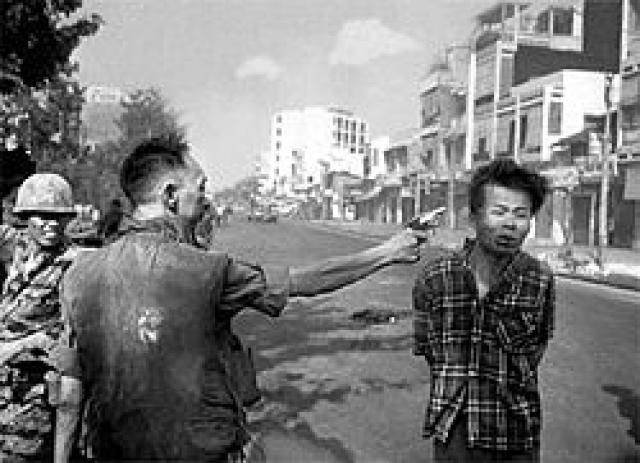
Nguen Loan
 Vietnam
Biography of Nguyen Ngoc Loan
Nguyen Ngoc Loan was a South Vietnamese brigadier general and the chief of police of South Vietnam. He was born on December 11, 1930, in a wealthy engineer's family in Hue, where he was one of eleven children. After graduating from Hue University, he joined the military and became a combat pilot in the South Vietnamese Air Force. During his service, Loan became friends with the commander of the Air Force, Nguyen Cao Ky. In 1965, when Ky became the prime minister of the country, he appointed his friend Loan as the chief of the South Vietnamese police.
The Incident during the Tet Offensive
Nguyen Ngoc Loan gained international notoriety among foreign journalists for his fiery speeches in response to attacks by National Liberation Front of South Vietnam (NLF) activists against civilians. On January 30-31, 1968, the first large-scale offensive by the NLF and the North Vietnamese Army, known as the Tet Offensive, began in South Vietnam. One of the main targets of the offensive was the capital city, Saigon, where urban warfare broke out. On February 1, the second day of the offensive, Nguyen Ngoc Loan (already promoted to brigadier general) was near the An Quang Pagoda, which had just been cleared of guerrillas by South Vietnamese forces. By chance, photojournalist Eddie Adams and NBC cameraman Vo Su were present and witnessed the following scene. South Vietnamese marines brought a captured NLF activist to Loan; according to reports, he was captured near a ditch where the bodies of tied-up and killed police officers and their families lay. The exact number of casualties varies; some sources claim that the deputy general was among those killed. Without uttering a word, Nguyen Ngoc Loan pulled out his revolver and aimed it at the guerrilla. Adams and Vo Su prepared to film, expecting the usual procedure of interrogation with the threat of weapons from the South Vietnamese police, but instead, Loan shot the guerrilla, turned to the journalists, and said, "They killed many of our people, and yours too" (according to another version, "These guys killed many of our people, and I think Buddha will forgive me"), and then walked away. Eddie Adams's photograph of Nguyen Ngoc Loan executing the guerrilla became one of the most famous photographs of the Vietnam War and a symbol of the brutality of civil war. Prime Minister Ky stated that the killed individual was a highly ranked NLF activist. The identity of the executed guerrilla was never conclusively established - there are two versions, one referring to an officer, the other to a political activist of the NLF. These individuals looked alike and both disappeared during the Tet Offensive. The fact that a prisoner of war was executed without trial or investigation, carried out by the chief of police of South Vietnam, caused a wave of outrage among the intellectual circles, and the photograph was widely used by the anti-war movement.
Life after the War
In early May 1968, during the second Battle of Saigon, Nguyen Ngoc Loan was wounded in the leg while leading an attack on a bridge controlled by the enemy. He was sent for treatment to Australia, but his arrival there caused such outrage that he was sent to a military hospital in the United States. The injury turned out to be severe, and Loan's right leg had to be amputated, after which he was retired. According to those close to Loan, he only demonstratively executed the guerrilla because foreign journalists happened to be nearby. After his injury and retirement, Loan dedicated most of his time to distributing gifts to homeless children in orphanages. In 1975, before the fall of Saigon, he asked Americans for help in escaping the country but was denied. However, he and his family managed to escape abroad, eventually settling in the United States.
In America, Loan settled in the state of Virginia, where he opened a pizzeria. When his identity became known to the American public in 1991, Loan was threatened with deportation as a war criminal. This was not carried out, but the former general's business declined. Unknown individuals wrote on the wall of his pizzeria: "We know who you are." General Loan died of cancer on July 14, 1998, leaving behind his wife, Chinh Mai, and five children. Eddie Adams, who turned down the prestigious Pulitzer Prize for his famous photograph, had the opportunity to apologize to Loan and his family for the image that had changed the general's life. After Loan's death, Adams wrote: "This guy was a hero. America should be crying. It's awful to see him go this way, when nobody knows anything about him."


