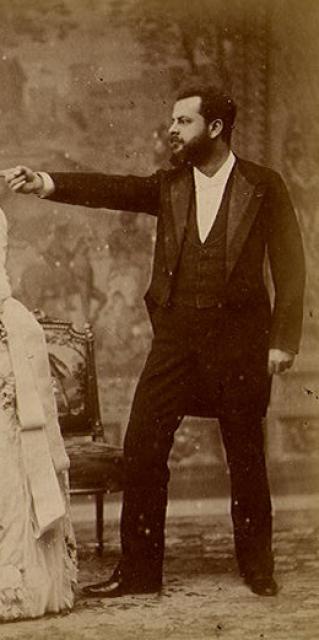
Jacques Damala
 Greece
Jacques Damala moved between two worlds that rarely came together so dramatically: Greek diplomacy and the bright, demanding theatre of late nineteenth-century Paris. Born Aristides Damalas, he became an actor and the husband of Sarah Bernhardt, whose fame cast a long shadow over their turbulent relationship. His life ended young, but Bernhardt’s sculpture of him and the stories surrounding their marriage kept his name in the public imagination.
Origins and Early Career
Damalas was born in Piraeus, Greece, on January 15, 1855. He came from a prominent Greek family and received schooling in Piraeus before spending several years abroad, including in England and France, where he studied diplomacy and encountered European society and theatre.
After returning to Greece in 1878, he entered military service. He later joined the Greek diplomatic corps as a military attaché, serving in Paris and St. Petersburg. The diplomatic path was respectable and secure, but Damalas was also drawn to acting. He began taking small parts and moving among theatre people, using the French stage name Jacques Damala.
Meeting Sarah Bernhardt
Damalas met Sarah Bernhardt in Paris around 1881. By then, Bernhardt was already an international star, celebrated for her stage presence and fiercely independent career. Their attraction quickly became a public story, and when Bernhardt travelled to St. Petersburg, she encouraged him to leave diplomacy and join her theatrical circle.
Damalas resigned from the diplomatic service and pursued acting. The couple married in London in 1882. Bernhardt was at the height of her fame, and her husband’s sudden arrival in her company brought attention as well as pressure. He acted alongside her, including in productions of “La Dame aux Camélias,” and appeared with her on tour. His acting drew interest, though he never built a career to match the stature of his celebrated wife.
A Turbulent Marriage
The marriage was marked by separations and reconciliations. Contemporary accounts and later scholarship describe Damalas’s morphine addiction and the strain it placed on his health and private life. The couple eventually divorced, though their relationship continued to shape Bernhardt’s story and his own public image.
Damalas was often presented through the lens of his romance with Bernhardt. In Greek newspapers, his beauty and dramatic relationship with the actress made him a romantic celebrity, while reports of his declining health and drug dependence contributed to a tragic narrative. Such accounts sometimes blurred biography with theatrical myth, and the surviving record reflects both the public fascination and the limits of what can be confidently reconstructed.
Final Years and Death
Damalas died in Paris on August 18, 1889, aged 34. The Metropolitan Museum of Art describes his death as the result of a drug overdose. Bernhardt responded by sculpting a marble funerary portrait of him, a poignant work that shows him as if asleep beneath a shroud. The sculpture transformed private grief into a lasting artistic memorial and remains one of the most visible traces of their relationship.
Legacy
Damalas is remembered less for a substantial body of acting work than for the collision of his ambitions with Bernhardt’s celebrity. He left diplomatic service to enter the theatre, became part of her company and shared an intense, unstable marriage with one of the era’s best-known performers. The marble portrait Bernhardt made after his death gives the story a final, intimate image: a young man remembered not only as a notorious celebrity husband, but also as the subject of a work of mourning by a major artist.