Jacques Le Goff
- A historian in the making
- The Annales approach
- Teacher and public intellectual
- Personal life and legacy
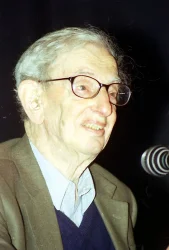
Jacques Le Goff helped change how historians imagine the Middle Ages. Rather than treating the era as a backdrop to kings and battles, he explored how people worked, traded, prayed, learned, and understood the world around them. A leading figure associated with the Annales school and the “New History,” he brought social and cultural questions to the center of medieval studies, while writing books that reached readers well beyond the academy.
A historian in the making
Le Goff was born in Toulon, France, on January 1, 1924. His father was a schoolteacher and his mother taught piano. As a boy, he became fascinated by the medieval world through books such as Walter Scott’s Ivanhoe. He later said that he wanted to teach history before he knew quite what it meant to be a historian.
After studying at the Lycée Louis-le-Grand in Paris, he entered the École normale supérieure in 1945. He pursued research in Prague and Oxford and spent a year at the École française de Rome. These experiences widened his perspective on European history and prepared him to work across national traditions and disciplines.
His first major book, The Intellectuals in the Middle Ages (1957), examined the emergence of scholars and urban intellectual life. It helped establish the direction of his career: he was interested not only in institutions and famous individuals, but in the structures, beliefs, and everyday practices that made a society work.
The Annales approach
Le Goff became part of the circle around the journal Annales, founded by Marc Bloch and Lucien Febvre and later shaped by Fernand Braudel. The Annales approach encouraged historians to draw on sociology, anthropology, economics, and geography, and to look beyond event-driven political narratives. Le Goff became a co-director of the journal and one of the most influential voices in the movement often called the “New History.”
His own research treated the Middle Ages as a complex and changing civilization. In The Birth of Purgatory (1981), he traced how the idea of purgatory developed into a distinct place in Christian thought and what that shift meant for medieval society. His studies of merchants, bankers, work, time, and religious life showed how beliefs and economic practices shaped one another.
Le Goff also returned to biography, a form some historians associated with older, more traditional history. His large study of Louis IX, Saint Louis (1996), explored not only the king’s life but the making of his image as ruler and saint. A later biography of Francis of Assisi similarly combined individual life with wider questions about religion, society, and memory.
Teacher and public intellectual
Le Goff taught and researched at the École pratique des hautes études, where he led its sixth section from 1972. That section became an autonomous institution, the École des hautes études en sciences sociales, in 1975; he served as its president until 1977. He remained an important teacher and mentor and helped create collaborative projects in the study of medieval society.
His influence also reached the public through radio. For decades, he hosted the French cultural program Les Lundis de l’Histoire, introducing listeners to historical scholarship and debate. He advised on historical themes in film and took part in public discussions about European history and identity.
Personal life and legacy
Le Goff married the Polish historian Hanka Dunin-Wąsowicz in 1962. Through her and his research trips, he developed a lasting interest in Poland and Eastern Europe. After her death in 2004, he wrote Avec Hanka, a personal reflection on their life together. They had two children.
Le Goff died in Paris on April 1, 2014, aged ninety. His scholarship made medieval life newly legible by connecting large historical changes with the ways people experienced time, money, faith, work, and community. He left behind a model of history that is rigorous but open to many kinds of evidence, and a picture of the Middle Ages as a world of its own rather than merely a prelude to modernity.