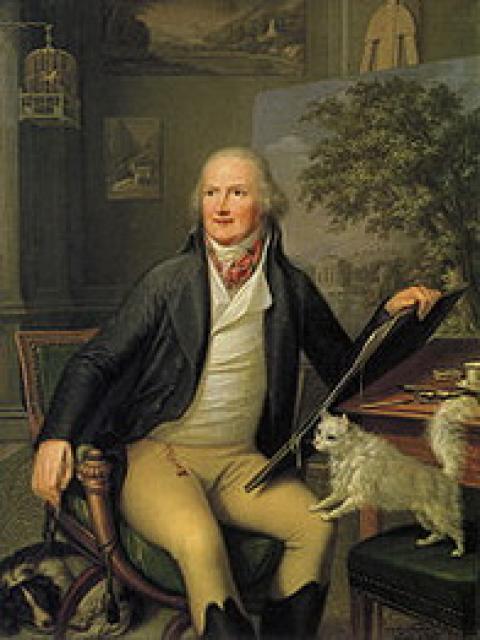
Jakob Philipp Hackert
 Germany
- Jakob Philipp Hackert: A Master of Landscape Painting
- Travels and Influence
- Italian Interlude and Royal Patronage
- Friendship with Goethe
- Classical Sensibility
- High-Profile Patronage
- The Battle of Chesme
- Legacy and Rediscovery
Jakob Philipp Hackert: A Master of Landscape Painting
Early Life and Artistic TrainingJakob Philipp Hackert, a renowned German landscape painter, was born into a family of artists. He initially trained under his father and uncle before pursuing his studies at the Berlin Academy of Arts.
Travels and Influence
In the early 1760s, Hackert embarked on an artistic journey through Scandinavia, including Stralsund, Rügen, and Stockholm. From 1765 to 1768, he visited France, exploring Paris, Normandy, and Picardy. These travels greatly influenced his artistic style.
Italian Interlude and Royal Patronage
Following his time in France, Hackert settled in Italy, becoming the court painter to King Ferdinand IV of Naples. During his tenure in Italy, which spanned several decades, Hackert established himself as one of the most successful landscape painters of the late 18th century.
Friendship with Goethe
Hackert developed a close friendship with the renowned German writer Johann Wolfgang Goethe. Goethe later published Hackert's biography in 1811, providing valuable insights into the artist's life and artistic process.
Classical Sensibility
As a representative of classicism, Hackert's landscapes exhibited a harmonious balance and clarity. He sought to capture the essence of nature through carefully constructed compositions and idealized forms.
High-Profile Patronage
Hackert's reputation extended across Europe, attracting the attention of high-ranking aristocrats. In Russia, he received commissions from Empress Catherine II, her son Paul Petrovich, and Count Yusupov.
The Battle of Chesme
Among Hackert's most famous works are his series of paintings depicting the Battle of Chesme. According to legend, Catherine II ordered the explosion of a ship before Hackert's eyes to ensure the accuracy of his portrayal. These paintings played a significant role in shaping Russian perceptions of the naval conflict.
Legacy and Rediscovery
After Hackert's death, his fame gradually faded. However, a successful exhibition at the State Hermitage Museum in the late 1990s reignited interest in his work, showcasing his extraordinary talent and the timeless appeal of his landscapes.