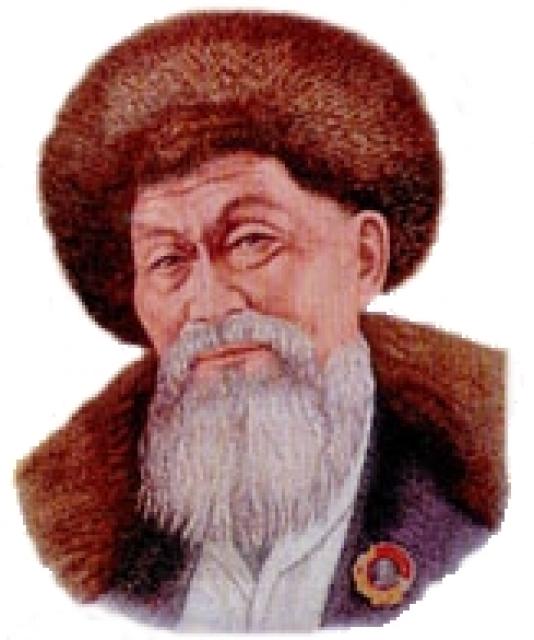
Jambul Jambaev
 Kazakhstan
- Jambul Jabayev: A Life Dedicated to Kazakh Folk Poetry
- Journey as a Wanderer
- Embracing the New Era
- Recognition and Legacy
- Response to the Great Patriotic War
Jambul Jabayev: A Life Dedicated to Kazakh Folk Poetry
Born into a poor nomadic family, Jambul Jabayev was a renowned Kazakh folk poet and akyn. Despite his humble beginnings, Jambul did not receive a formal education. However, he learned the art of song and improvisation from the famous akyn Suyumbay.
Journey as a Wanderer
In 1897, at the age of 52, Jambul left his home and traveled from village to village, earning a living through his singing. Accompanied by the sound of the dombra, he performed in the style of tolgaу, a form of recitation. During the late 19th and early 20th centuries, he participated in various akyn competitions, known as aitys, and emerged as the victor. Jambul gained a reputation as a master of satirical songs.
Eventually, his pre-revolutionary repertoire included epic tales such as Suranshi-batyr, Utegen-batyr, and folk legends like Khan and Akyn, The Tale of the Lazy One, and many others.
Embracing the New Era
After the October Revolution, Jambul, already widely known for his talent, began incorporating new themes into his work. His songs now glorified the Soviet Union and its leaders. Some of his famous compositions during this period included "Hymn to October" (1936), "My Homeland" (1936), "In the Mausoleum of Lenin" (1936), and "Lenin and Stalin" (1936). Jambul imbued these songs with epic characteristics, likening the Soviet leaders to legendary heroes and warriors. His songs were widely disseminated by the authorities as they genuinely celebrated life in the USSR.
Recognition and Legacy
With his portrayal as an Eastern wise elder who embraced the new order and its people, Jambul became the most respected akyn in Kazakhstan, and his songs became an integral part of Kazakh village life. In 1938, Jambul became a deputy of the Supreme Soviet of the Kazakh SSR and received multiple awards, including the Order of Lenin. Despite his accolades, he continued to live in his village.
As Jambul only wrote in Kazakh, a team of translators and editors, including P. Kuznetsov, K. Altai, and M. Tarlovsky, worked on translating his songs into Russian and other languages of the Soviet peoples. There is a belief that some of his songs, overflowing with praise for Stalin, were actually written by his translators and editors. Nevertheless, Jambul's works gained wide popularity and received nationwide support.
Response to the Great Patriotic War
During the events of the Great Patriotic War, Jambul responded with widely circulated patriotic works that mobilized the Soviet people to fight against the German fascist invaders. Some of his notable compositions during this period included "People of Leningrad, My Children!" (1941) and "In the Hour When Stalin Calls" (1941). In 1941, he became a laureate of the Stalin Prize. Jambul passed away on June 22, 1945, in Almaty, at the age of 99. In his honor, a city in Kazakhstan was named after him.
Jambul Jabayev's poetic style was characterized by psychological depth, vivid depictions of social life, emotional storytelling, and epic simplicity. He seamlessly blended oral and literary forms, poetic verses with prose fragments. His songs remain a vibrant chapter in Kazakh literature from the Soviet era.


