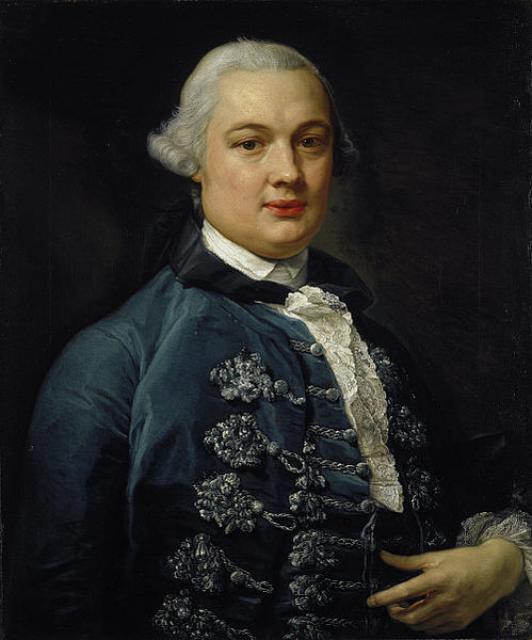
James Bruce
 Great Britain
- Early Life and Education
- Marriage and Early Career
- Journey to North Africa
- Exploration of Ancient Ruins and Overland Travel
- Journey to the Levant
- Quest for the Source of the Nile
- Arrival in Ethiopia
- Discovery of the Blue Nile
- Lake Tana and the Blue Nile
- Dispute over the Discovery
- Return Journey and Publications
- Legacy
Early Life and Education
James Bruce, a Scottish traveler and writer, was born in Scotland in the Kinnaird family seat in Stirlingshire. He received his education at Harrow School and Edinburgh University.
Marriage and Early Career
After graduating, Bruce initially studied law but pursued wine trade after marrying the daughter of a wine merchant. Following his wife's untimely demise in 1754, he embarked on a voyage to Portugal and Spain.
Journey to North Africa
In 1762, Bruce presented a plan to attack Ferrol during the war with Spain. Although rejected, it brought him to the attention of George Montague-Dunk, 2nd Earl of Halifax, who appointed him as British consul to Algiers.
Exploration of Ancient Ruins and Overland Travel
Bruce arrived in Algiers in 1763 and spent time studying ancient ruins on the Barbary Coast. He then traveled overland from Tunis to Tripoli and sailed from Ptolemeta to Candia, experiencing a shipwreck near Benghazi.
Journey to the Levant
Brute traveled extensively through the Levant, exploring ancient ruins and learning medicine. He visited Palmyra and Baalbek in Syria, further broadening his knowledge of ancient civilizations.
Quest for the Source of the Nile
In 1768, Bruce arrived in Alexandria, determined to find the source of the Nile River. With support from the Mamluk ruler Ali Bey, he journeyed through Egypt and eventually reached Massawa, which was under Turkish control.
Arrival in Ethiopia
On February 14, 1770, Bruce reached Gondar, the then-capital of Ethiopia. He gained favor with the Ethiopian rulers and spent two years studying their culture and history.
Discovery of the Blue Nile
In October 1770, Bruce embarked on a perilous expedition to the source of the Blue Nile. Guided by Balugani, a royal confidant, and a Greek named Strates, he reached the alleged source on November 4, 1770.
Lake Tana and the Blue Nile
On November 14, 1770, Bruce arrived at Lake Tana, confirming it as the source of the Blue Nile. Despite recognizing the White Nile's greater size, he claimed the Blue Nile to be the "ancient" Nile, arguing that he had discovered its true source.
Dispute over the Discovery
While claiming to be the first European to discover the Blue Nile's source, Bruce's claim has been disputed. It is now commonly accepted that the Jesuit missionary Pedro Paes was the first to find it in 1618.
Return Journey and Publications
In 1773, Bruce returned to Cairo and later to France, where he faced skepticism about his travels. In 1790, he published his "Travels to Discover the Source of the Nile", which was met with mixed reactions.
Legacy
Despite the controversy, Bruce's accounts of his travels and discoveries provided valuable insights into African geography. His collection of Ethiopian manuscripts also contributed significantly to the study of Ethiopian languages and culture.


