James Ewell Brown
 USA
USA- Biography of James Ewell Brown Stuart
- Early Military Career
- Reconnaissance and Raiding
- Promotions and Notable Engagements
- Chancellorsville and Gettysburg
- Final Years and Death
Biography of James Ewell Brown Stuart
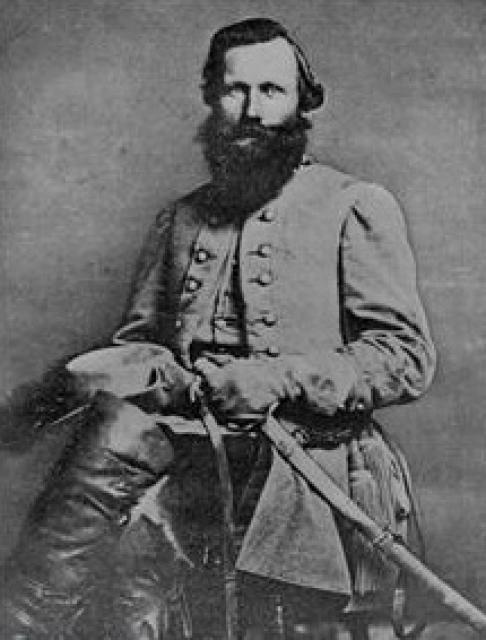
James Ewell Brown Stuart, known as Jeb Stuart, was born in 1833. He attended the United States Military Academy at West Point, graduating in 1854. However, when Virginia seceded from the Union in April 1861, Stuart resigned from the U.S. Army to defend his state.
Early Military Career
Stuart displayed exceptional personal courage in his first battle at Bull Run in July 1861. Later that same year, he was promoted to brigadier general and appointed commander of the cavalry brigade in the Army of Northern Virginia.
Reconnaissance and Raiding
Before the Seven Days Campaign, General Robert E. Lee sent Stuart on a raid around the right flank of the Union Army under General George McClellan. Stuart not only successfully completed this mission but also circled the entire McClellan's army, providing Lee with crucial information about the enemy's strength and position.
Promotions and Notable Engagements
Promoted to major general and given command of the Confederate cavalry corps, Stuart fought in the Second Battle of Bull Run in August 1862, where he again conducted a raid around the Union Army, capturing 1,200 enemy horses. In the subsequent Maryland Campaign, Stuart effectively covered one of the crossings through the South Mountain, allowing General Lee to concentrate his forces and repel McClellan's attack.
By the winter of 1862, Stuart's unprecedented abilities as an intelligence officer were widely recognized, and Lee referred to him as the "eyes of the army." In the Battle of Fredericksburg in December 1862, Stuart's cavalry artillery provided valuable assistance by warning of the Federal attack on General Jackson's corps.
Chancellorsville and Gettysburg
In May, during the Battle of Chancellorsville, Stuart was appointed to command the Second Corps of the army after General Jackson was wounded. The following campaign in Gettysburg, Pennsylvania, was preceded by a cavalry battle at Brandy Station on June 9th, in which Stuart and his men encountered significant resistance from the Federal cavalry for the first time.
Stuart's cavalry corps covered the Confederate army's northward movement towards the Potomac River, moving along the right flank. However, his actions, influenced by conflicting orders, resulted in him circumventing the Union army, leaving Lee without his "eyes and ears" on the battlefield. Arriving at Gettysburg on the second day of the battle, Stuart attempted to break through the enemy's flanks but failed in a battle against Gregg's and Custer's cavalry.
During the retreat from Pennsylvania, Stuart managed to redeem himself by successfully defending Confederate supply wagons in Williamsport.
Final Years and Death
Throughout the winter of 1863-1864, Stuart continued to provide accurate information about the movements of Union forces to the Confederate command. However, early in the 1864 campaign, his cavalry corps was cut off from General Lee's army by General Philip Sheridan's Union cavalry.
On May 5, 1864, Stuart's cavalry led the advance of General A.P. Hill's corps in an attack on General Ulysses S. Grant. While attempting to prevent the enemy's movement towards Spotsylvania, Stuart launched a counterattack against the main Union forces but was distracted by a sudden raid by Sheridan. In the Battle of Yellow Tavern on May 11, Stuart was severely wounded and died the following day.