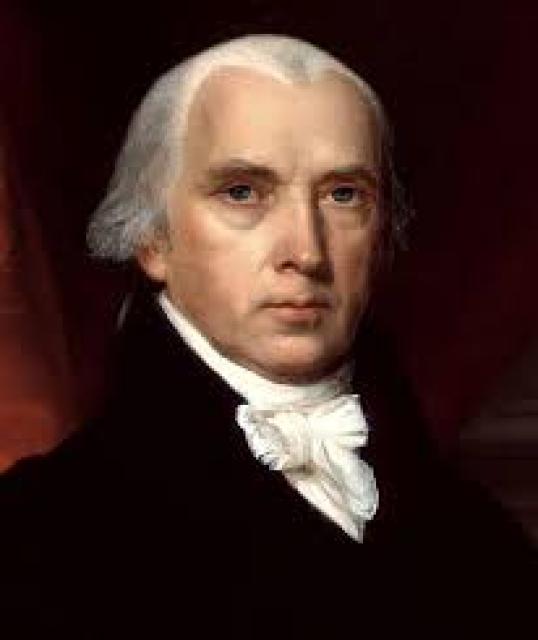
James Medison
 USA
USAJames Madison Biography
James Madison, the 4th President of the United States, was born on March 16, 1751, in Port Conway, Virginia. He received a private education and enrolled in Princeton University in 1769, graduating in 1771. While at college, he became a member of the American Whig Society, a debate club, which shaped his future interests.
Madison first gained attention in Virginia in 1775 when he was appointed chairman of the revolutionary safety committee in Orange County and authored anti-British resolutions. After being elected to the Virginia Constitutional Convention in 1776, he became a member of the committee responsible for drafting both the Declaration of Rights and the state's constitution. Madison also proposed an amendment to separate church and state in Virginia, which was initially rejected but later accepted. He was elected as a member of the first Virginia Assembly under the new state government, which he played a role in creating. After losing reelection, he was appointed as a member of the governor's council in 1777. Three years later, he was elected as a representative of Virginia to the Continental Congress and remained an active participant from 1780 to 1783. During this time, he introduced amendments that granted Congress financial powers to collect taxes from states, impose import duties, and distribute interest on the national debt proportionally to the population. Madison's early interest in the West reflected in his repeated demands for the freedom of navigation on the Mississippi River. In 1782, he proposed a compromise plan in which Virginia agreed to cede some of its western territory to the central government. Instead of accepting a position as envoy to Spain, Madison returned to Virginia in November 1783 and was elected to the state assembly a year later, where he successfully fought for the passage of Jefferson's bill for religious freedom on December 26, 1785.
Madison's most significant achievement during these years was organizing the movement to replace the weak and decentralized government provided by the Articles of Confederation with a strong national government. He fervently supported the trade conferences held at Mount Vernon and Annapolis in 1785-1786 and, along with Alexander Hamilton, worked towards gaining delegates' approval to convene the Constitutional Convention in Philadelphia. Even before the convention in 1787, Madison prepared a list of proposals for the new system of government, many of which were included in the Virginia Plan presented to the convention. Madison insisted on creating a strong national government and even proposed granting Congress veto power over laws passed by the states. He became one of the leading participants in the debates, and his notes, first published in 1840, remain the primary source of information on the creation of the United States Constitution. Madison was also at the forefront of defending the new constitution and authored 24 of the 85 Federalist Papers, second only to Hamilton, in his efforts to ensure its ratification by the states. Despite strong anti-federalist opposition led by Patrick Henry and George Mason, he managed to push it through his state's convention. After being defeated by anti-federalists in the U.S. Senate elections, Madison was elected to the first House of Representatives. During the first session of Congress, Madison collaborated with the new Secretary of the Treasury, Alexander Hamilton, by proposing and supporting measures. Congress approved the resolutions prepared by Madison, which provided for the creation of departments and agencies of the new government. Additionally, he proposed six out of the first ten amendments to the U.S. Constitution, commonly known as the Bill of Rights. However, during the second session of Congress, Madison opposed Hamilton's proposals for debt repayment and reluctantly agreed to assume state debts by the federal government. He criticized the Bank of the United States bill, the decision to increase import tariffs, and the pro-British foreign policy. By 1792, Madison had become the leader of the group forming the Democratic-Republican Party, and four years later, he supported Jefferson against Adams in the presidential elections.
After leaving Congress in 1797, Madison intended to permanently settle in Montpelier, Orange County, Virginia. However, the passage of the Alien and Sedition Acts in 1798 prompted him to re-engage in political activities. In protest, he prepared the Virginia Resolutions, modifying similar resolutions drafted by Jefferson and passed by the Kentucky legislature. Madison declined Jefferson's offer to become the Democratic-Republican candidate for president and instead supported Jefferson's candidacy. After Jefferson's election, Madison was appointed Secretary of State. Throughout his eight-year tenure, he implemented the foreign policy course of the Democratic-Republicans, although the primary role in shaping it likely belonged to the president.
In 1808, Madison himself was elected president, defeating Charles Pinckney. As the head of state, he attempted to maintain the spirit and political course of Jefferson's administration but failed to protect the right of the United States to neutrality through the use of economic coercion against warring European powers. In 1810, these measures were directed against Great Britain, and a year later, Madison essentially acknowledged that the principles of Jefferson's embargo were incorrect. On June 1, 1812, Madison appealed to Congress to declare war on Britain. Until the end of the war, the country experienced chaos, threats of secession, and financial difficulties. The war ended in humiliation after the British captured and burned Washington. Following Madison's proposal, the peace terms maintained the territorial status quo ante bellum. During the last two years of his presidency, Madison and his party responded to nationalist sentiments by adopting many measures previously proposed by the Federalists. In a short period, laws were approved and signed for the creation of the Second Bank of the United States and a protective tariff on imports.
In March 1817, Madison left the presidency and retired to Montpelier. He actively worked on publishing his notes on the Constitutional Convention and maintained a keen interest in the affairs of his state. Among all the national issues of the time, he was most concerned about the issue of slavery. During the crisis of 1832-1833, which arose due to the nullification of tariffs in South Carolina, Madison strongly rejected claims that the doctrines proclaimed in the Virginia and Kentucky Resolutions sanctioned nullification or secession. Madison passed away in Montpelier on June 28, 1836.


